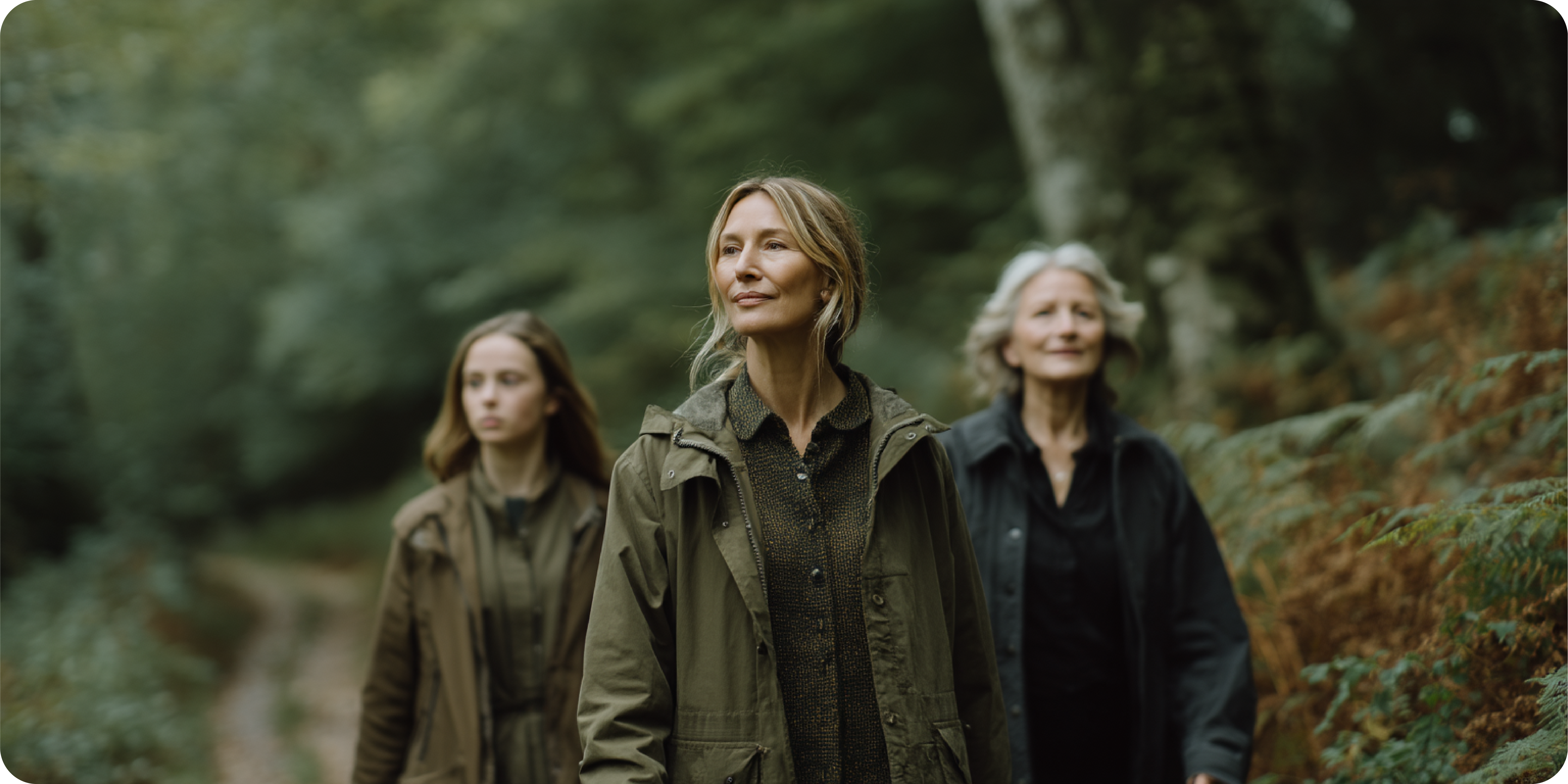
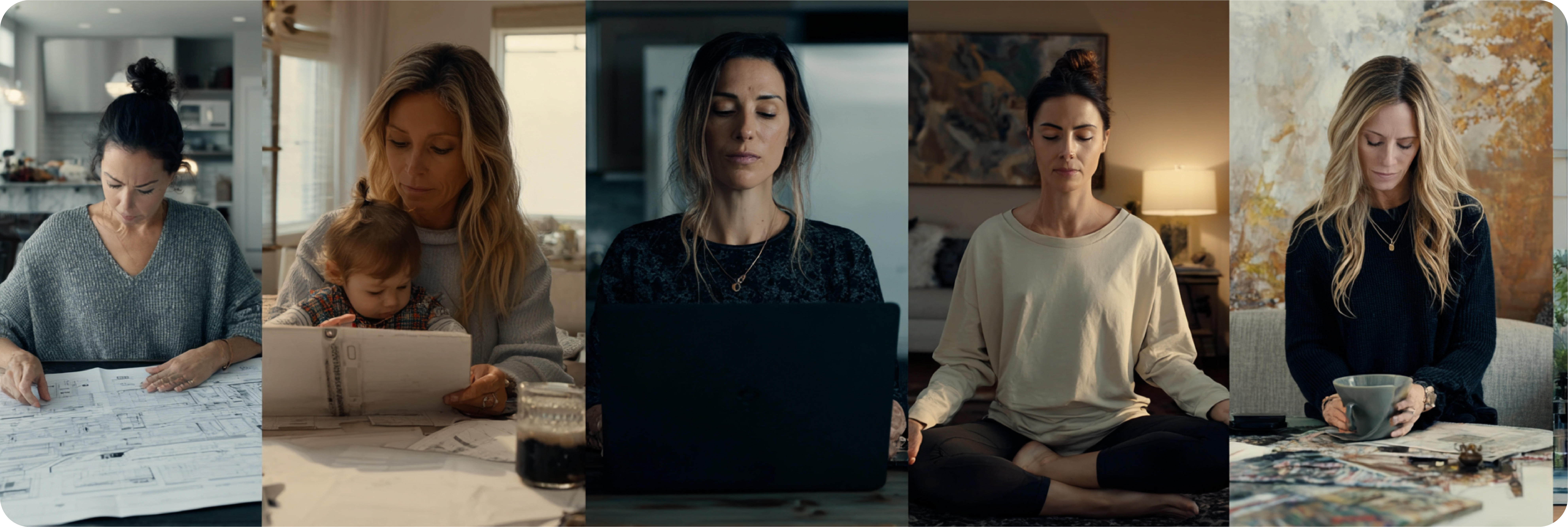
> For the complete documentation index, see [llms.txt](https://lumeon.gitbook.io/lumeon-archive/llms.txt). Markdown versions of documentation pages are available by appending `.md` to page URLs; this page is available as [Markdown](https://lumeon.gitbook.io/lumeon-archive/unsorted/wildflower-club/archetypes.md).

# Archetypes

> *<mark style="color:$primary;">**You are not a type. You are an energy.**</mark>*

<figure><img src="https://2090198475-files.gitbook.io/~/files/v0/b/gitbook-x-prod.appspot.com/o/spaces%2Fo3uM7cY7RMOdagDCu1WD%2Fuploads%2FIx3rAtrPgdU3hTfjwkyx%2Farchetypes_hero.png?alt=media&amp;token=7990d76a-18a0-49d3-a0b1-7856afaab2ac" alt=""><figcaption></figcaption></figure>

#### **A living village does not need a single kind of woman. It needs five kinds of energy, held in dynamic relationship, each essential to the whole.**

Every woman carries within her a constellation of energies: the drive to create, the instinct to connect, the courage to transform, the wisdom to discern, and the capacity to feel what has not yet been spoken. These energies are not personality traits or behavioral preferences. They are fundamental orientations, ways of engaging the world that shape how a woman leads, loves, creates, and contributes.

In most women, one of these energies is dominant. Not exclusively present, but consistently primary: the lens she reaches for first, the mode she operates from under pressure, the gift others recognize in her before she names it herself. We call this her center of gravity.

The five archetypal energies at the heart of Wildflower Club are: **Builder**, **Weaver**, **Alchemist**, **Tender**, and **Sage**. Together, they form the minimum viable diversity required for a community to sense, respond, and evolve as a living system. Separately, each represents a distinct way of being in the world, with its own power, its own shadow, and its own irreplaceable contribution to the village.

## **Why Archetypes Matter**

Wildflower Club is not built for one kind of woman. It is built for the full spectrum of feminine energy, from the most action-oriented to the most receptive, and every configuration between. The archetype framework exists to ensure this breadth is intentional, not accidental.

It serves three functions within the ecosystem:

<mark style="color:$primary;">**Self-recognition**</mark>\
A woman encountering the five archetypes should feel a pull toward one. Not a label imposed from outside, but an inner recognition: "that energy is mine." This moment of identification is the beginning of a relationship with the framework, not the end of it. She may discover over time that her center of gravity shifts, or that a secondary energy is stronger than she initially thought. The framework holds space for this movement.

<mark style="color:$primary;">**Developmental invitation**</mark>\
If your center of gravity is the energy you lead with, your developmental edge is the energy you have not yet fully inhabited. A Builder who runs on vision and momentum may discover that her greatest growth lives in the Tender dimension: learning to feel, to pause, to sustain rather than initiate. A Sage who holds deep wisdom may discover that her edge is Alchemist territory: surrendering the known and entering the fire of genuine transformation. The 8 Domains provide the landscape for this cultivation. The archetypes reveal where the invitation lives.

<mark style="color:$primary;">**Ecosystem intelligence**</mark>\
A village composed entirely of Builders would be visionary and productive, but it would burn out. A village of only Sages would be wise but slow to act. A village of only Tenders would be deeply attuned but struggle to create structure. The five archetypes together form a complete organism: one that can sense, decide, create, sustain, and evolve. Wildflower Club actively cultivates all five energies in its composition, governance, programming, and culture. This is not diversity for its own sake. It is the structural requirement for a living system to navigate complexity.

<figure><img src="https://2090198475-files.gitbook.io/~/files/v0/b/gitbook-x-prod.appspot.com/o/spaces%2Fo3uM7cY7RMOdagDCu1WD%2Fuploads%2FZaMJavJOFgZsLY1tBr2c%2Farchetype%202.png?alt=media&amp;token=2f86f7ea-6469-4b88-baaf-ac268c0015fd" alt=""><figcaption><p><mark style="color:$primary;"><strong>The moment of recognition:</strong></mark> not being told who you are, but seeing yourself clearly for the first time in a framework that makes sense.</p></figcaption></figure>

## **How Identification Works**

The archetypes are offered as mirrors, never imposed as classifications. When a woman enters the ecosystem, she encounters the five energies through Wildflower Compass and through the community itself. She is invited to explore which energy she leads with. No test assigns her a type. No algorithm sorts her into a category.

This matters because the framework is designed for sovereignty. A woman who has been told her whole life who she should be does not need another system telling her who she is. She needs a framework that trusts her to recognize herself, and then supports her in developing beyond what she already knows.

Over time, a member's relationship with the archetypes deepens. She may arrive identifying as a Builder and discover, three seasons in, that her truest center of gravity is Weaver. She may find that a life transition activates Alchemist energy she never knew she carried. She may develop her Tender dimension so thoroughly that it becomes a co-primary alongside her original archetype. All of this is expected. All of it is healthy. The framework is a living tool, not a fixed map.

What remains constant is the principle: every woman carries all five energies. Her center of gravity is simply where she begins. The Journey is where she discovers the rest.

## **The Five Archetypes**

*<mark style="color:$primary;">Five portraits. One village.</mark>*

What follows are five portraits of energy, not five descriptions of people. Each archetype represents a fundamental orientation: a way of sensing, engaging, and contributing that is present in every woman but expressed with different intensity and depth.

The portraits are presented in a consistent format. The surface layer offers recognition: who she is, how she moves, what she brings, and where her shadow lives. The profile map (collapsible) offers depth: how this energy expresses across the WFC ecosystem, from Domain affinities to Circle dynamics to governance contribution. The surface is for every reader. The profile map is for the team, for Culture Keepers, and for the woman who wants to understand her own energy at a deeper level.

The five are presented in a specific order: from the most externally active energy (Builder) to the most internally attuned (Sage), with Tender at the center as the embodied ground that all the others need to sustain themselves.

### <mark style="color:$primary;">**Builder**</mark>

*The Creative Force*

<figure><img src="https://2090198475-files.gitbook.io/~/files/v0/b/gitbook-x-prod.appspot.com/o/spaces%2Fo3uM7cY7RMOdagDCu1WD%2Fuploads%2FXB3NG83lo9lA9vjHI2WO%2FThe%20Builder.png?alt=media&amp;token=423ba0da-e88c-47b9-99fa-7de2931f6cfd" alt=""><figcaption></figcaption></figure>

#### <mark style="color:$primary;">**Energy**</mark>

> *Builder is the force that sees what does not yet exist and moves toward it.*

#### <mark style="color:$primary;">**Portrait**</mark>

She is the woman who looks at the world and instinctively sees what is not there yet, the company that should exist, the system that should work differently, the thing that needs to be made. Builder energy is fundamentally creative: not in the decorative sense, but in the structural one. She brings form to the formless. She starts things, shapes things, and drives them forward with a momentum that others find either inspiring or exhausting, and often both.

Builder is not defined by what she builds. She may be founding a company, designing a home, raising children with fierce intentionality, or reshaping a team culture from the inside. What defines her is the orientation: she looks at the world and sees what is missing, then moves to fill the gap. She is most alive when something is taking shape under her hands. She thinks by making. She processes by doing. She trusts action over contemplation, and she has learned (or is learning) that this instinct is both her greatest strength and her most reliable blind spot.

#### <mark style="color:$primary;">**Shadow**</mark>

When Builder energy runs unchecked, creation becomes compulsion. She builds past the point of sustainability, confusing output with worth. Rest feels like failure. Receiving feels like weakness. She over-identifies with her projects to the point where a setback in the work feels like a collapse of self. The shadow of Builder is the woman who has built an impressive life and cannot feel it, because she is already reaching for the next thing. Her body carries the cost of what her mind will not slow down to acknowledge.

#### <mark style="color:$primary;">**What She Brings to the Village**</mark>

Builder is the one who asks: *"What are we creating?"*

Without her, the village has no direction. She provides vision, initiative, and the momentum that turns ideas into tangible reality. When a Circle needs a new structure, she designs it. When the community faces a challenge, she is already sketching solutions. She is the engine of forward movement.

#### <mark style="color:$primary;">**Sub-types**</mark>

The three expressions of Builder energy differ in scale and medium, but share the same fundamental impulse: something needs to exist, and she is going to make it happen.

<mark style="color:$primary;">**Founder**</mark>\
Entrepreneurial energy. She starts ventures, movements, and initiatives from zero. Her gift is the ability to see an opportunity where others see a void, and to build the first version of something before the conditions are perfect.

<mark style="color:$primary;">**Maker**</mark>\
Hands-on creative. She designs, crafts, and builds tangible things. Her gift is in the translation between idea and material: she thinks with her hands and trusts the intelligence of the making process itself.

<mark style="color:$primary;">**Architect**</mark>\
Systems-level thinker. She designs structures, frameworks, and models. Her gift is seeing how the parts relate to the whole and building systems that are elegant, functional, and resilient.

#### <mark style="color:$primary;">**Polarity: Tender**</mark>

Builder's greatest developmental edge is Tender energy. The woman who builds relentlessly needs to learn to feel, to pause, to sustain rather than always initiate. Her growth lives in the Soma and Mystery Domains: reconnecting with her body's intelligence and opening to what cannot be planned or produced. The journey from "What am I building?" to "What am I feeling?" is Builder's most transformative passage.

<details>

<summary><mark style="color:$primary;"><strong>Profile Map</strong></mark></summary>

#### <mark style="color:$primary;">**Energetic Signature**</mark>

Initiating, forward-moving, form-giving. Fire and earth.

#### <mark style="color:$primary;">**Orientation**</mark>

Engages the world through action and creation. Processes experience by making something from it. Orients toward the future and toward what is possible.

#### <mark style="color:$primary;">**Superpower**</mark>

The ability to manifest. She closes the gap between vision and reality faster than anyone in the room. When Builder is in flow, things that seemed impossible last week are taking shape by Friday.

#### <mark style="color:$primary;">**Shadow Expression**</mark>**&#x20;**<sup>**(expanded)**</sup>

Builder's shadow operates on two levels. On the surface: overwork, inability to rest, identity fused with productivity. Deeper: a fear that without her output, she has no value. This often traces to early conditioning where she was praised for achievement and invisible when still. In community, shadow Builder can dominate space, move too fast for others, dismiss process in favor of progress, and create resentment by treating collaborative spaces as her personal workshop.

#### <mark style="color:$primary;">**Core Need**</mark>

A grounding practice and a circle of women who understand the weight and thrill of creation. She needs to be met in her intensity without being asked to dim it, and she needs mirrors who will lovingly reflect when she is running on fumes.

#### <mark style="color:$primary;">**What Brings Her to the Door**</mark>

Builder rarely arrives because she is "seeking personal growth." She arrives because something she built has stalled, broken, or succeeded without making her feel the way she expected. She may be post-launch and empty, mid-burnout and unable to admit it, or at a creative crossroads where the old way of building is no longer working. She often frames her entry in practical terms ("I need better systems for my life") before discovering that what she actually needs is deeper than productivity.

#### <mark style="color:$primary;">**Domain Affinities**</mark>

* *<mark style="color:$primary;">Primary</mark>*\
  **Craft** (creative expression, making), **Matter** (resources, economics, building systems)
* *<mark style="color:$primary;">Secondary</mark>*\
  **Voice** (articulating vision), **Civics** (systems leadership)

#### <mark style="color:$primary;">**Developmental Edge**</mark>

* *<mark style="color:$primary;">Growth Domains:</mark>* Soma (returning to the body, learning to feel before acting), Mystery (surrendering control, opening to what cannot be planned)
* *<mark style="color:$primary;">Polarity Practice:</mark>* Learning the Tender arts of attunement, patience, and receptivity. Developing the capacity to sustain rather than always initiate.

#### <mark style="color:$primary;">**Seasonal Resonance**</mark>

* *Most activated:* Seeding (new beginnings, vision, initiative) and Harvest (completion, contribution, seeing results)
* *Growth season:* Stillness (the season Builder resists most and needs most)

#### <mark style="color:$primary;">**In a Circle**</mark>

Builder often takes initiative: she suggests structures, proposes solutions, and moves the group toward action. She may need to practice sitting with a question rather than solving it. Culture Keepers can support Builder by honoring her momentum while creating space for the slower, receptive energies in the group. She is often the first to volunteer and the last to ask for support.

#### <mark style="color:$primary;">**In Governance**</mark>

Builder brings strategic vision, decisiveness, and the ability to translate discussion into action. She is excellent at identifying what needs to be built and mobilizing resources. Her risk in governance is moving faster than collective consent allows, or treating governance as a problem to solve rather than a relationship to tend.

#### <mark style="color:$primary;">**Her Contribution to Commons**</mark>

Builder is likely among the first to create and publish offerings. Her natural output is tools, frameworks, templates, and structured programs. A Builder-Founder might create a "Launch Your First Project" workshop. A Builder-Architect might publish a systems design template. Her risk in Commons is over-producing: shipping quantity over depth. Quality protocols serve Builder by giving her a standard to build toward rather than a volume to fill.

#### <mark style="color:$primary;">**Recognition Signals**</mark>

You might be leading with Builder energy if: you have multiple projects running at all times, you feel restless when nothing is being created, people come to you when they need something made real, you think in plans and prototypes, you find it easier to give than to receive, and your idea of self-care is starting a new project.

#### <mark style="color:$primary;">**Archetype in the Wild**</mark>

The startup founder who builds three ventures before she is 35. The mother who redesigns her family's entire routine after reading one book on child development. The designer who cannot stop iterating. The community organizer who sees a gap and fills it before anyone has finished describing the problem.

#### <mark style="color:$primary;">**Builder Across Life Stages**</mark>

<mark style="color:$primary;">**Emerging**</mark>\
She is starting everything at once. Three side projects, a new job, a vision board that changes monthly. Her energy is high and unfocused. She needs the framework to channel her creative force without dampening it.

<mark style="color:$primary;">**Becoming**</mark>\
She is building something real and hitting the first walls. The gap between vision and execution is wider than she expected. She may be learning for the first time that she cannot build her way out of an emotional problem.

<mark style="color:$primary;">**Carrying**</mark>\
She is the architect of her household, her team, her community. She builds systems for everyone else's lives and has no system for her own inner world. She arrives at WFC when the infrastructure she built starts to feel like a cage.

<mark style="color:$primary;">**Ripening**</mark>\
She has built enough to know that building is not the answer to every question. She is asking what to build next, and for the first time, the answer might be "nothing." She is learning to let something emerge rather than forcing it into existence.

<mark style="color:$primary;">**Deepening**</mark>\
She has a lifetime of built things behind her. Her Builder energy is now channeled into mentorship, legacy, and the architecture of systems that will outlast her. She may be the most valuable Builder in the ecosystem because she builds for the long arc, not the next quarter.

#### <mark style="color:$primary;">**Visual Mood**</mark>

<figure><img src="https://2090198475-files.gitbook.io/~/files/v0/b/gitbook-x-prod.appspot.com/o/spaces%2Fo3uM7cY7RMOdagDCu1WD%2Fuploads%2FukWVOJ5mBGdY2EcG2CCm%2Fbuilder%202.png?alt=media&amp;token=79ae1e39-b7af-48f7-b8ce-07bf9563570e" alt=""><figcaption><p><mark style="color:$primary;"><strong>Builder in her element:</strong></mark> the space between vision and reality, where her hands do the thinking.</p></figcaption></figure>

</details>

### <mark style="color:$primary;">**Weaver**</mark>

*The Integrative Force*

<figure><img src="https://2090198475-files.gitbook.io/~/files/v0/b/gitbook-x-prod.appspot.com/o/spaces%2Fo3uM7cY7RMOdagDCu1WD%2Fuploads%2FRq7V7SvMphKKXTks3VZj%2Fweaver_hero2.png?alt=media&amp;token=876f2543-7318-4627-9514-aa60269c510c" alt=""><figcaption></figcaption></figure>

#### <mark style="color:$primary;">**Energy**</mark>

> Weaver is the force that sees how things connect and holds them together.

#### <mark style="color:$primary;">**Portrait**</mark>

She is the woman who walks into a room and instinctively reads the relational field: who is at ease, who is struggling, what is being said and what is being withheld, where the thread of connection has frayed. Weaver energy is fundamentally integrative. She does not create from nothing like Builder. She creates coherence from complexity. She holds the family, the team, the friendship, the project, the community together by understanding, often without conscious effort, how the parts form a whole.

Weaver is not defined by a role. She may be a project manager synthesizing competing priorities, a mother holding a household in motion, a therapist tracking the threads of a client's story, or a friend who always remembers the thing you mentioned three months ago and follows up. What defines her is the orientation: she sees relationships where others see objects. She experiences the world as a web of connections, and her deepest instinct is to strengthen that web. She thinks relationally. She leads through attunement. She builds trust so quietly that people often do not realize she is the reason the system works until she steps away and everything unravels.

#### <mark style="color:$primary;">**Shadow**</mark>

When Weaver energy runs unchecked, integration becomes self-erasure. She holds so many threads that she loses her own. She becomes so attuned to what everyone else needs that she cannot locate what she needs. The question "What do you want?" produces a blank, not because she lacks desire but because desire has been buried under layers of responsiveness. The shadow of Weaver is the woman who sustains an entire ecology of relationships and collapses in private because no one is holding her thread. She mistakes her own depletion for selflessness and calls her disappearing a virtue.

#### <mark style="color:$primary;">**What She Brings to the Village**</mark>

Weaver is the one who asks: *"How does this all connect?"*

Without her, the village fragments. She provides relational intelligence, integration, and the steady connective tissue that holds complex systems together. When a Circle loses its rhythm, she feels it before anyone can articulate it. When two initiatives are duplicating effort, she sees the bridge. When a new member arrives feeling lost, Weaver is the one who quietly makes sure she is woven in.

#### <mark style="color:$primary;">**Sub-types**</mark>

The three expressions of Weaver energy differ in context and scale, but share the same fundamental orientation: the world is a web of relationships, and her work is to keep that web strong.

<mark style="color:$primary;">**Integrator**</mark>\
She navigates career, family, and inner life simultaneously. Her gift is the ability to hold multiple complex systems in dynamic balance without letting any one collapse. She is the woman who manages a team, parents two children, and maintains a marriage not through rigid scheduling but through a fluid, intuitive sense of what needs attention now.

<mark style="color:$primary;">**Bridge**</mark>\
The natural connector. She links people, ideas, communities, and worlds that would not otherwise meet. Her gift is the ability to see complementarity where others see difference. She introduces the artist to the strategist. She translates between the visionary and the operator. She creates relationships that create value for everyone involved.

<mark style="color:$primary;">**Caregiver**</mark>\
She holds family or community systems with steady, sustaining hands. Her gift is the quality of her attention: consistent, reliable, attuned to what is needed before it is asked for. She is the infrastructure that others depend on and rarely see, the one who remembers, who follows up, who shows up, who stays.

#### <mark style="color:$primary;">**Polarity: Tender**</mark>

Weaver's greatest developmental edge is Alchemist energy. The woman who integrates and stabilizes needs to learn to disrupt, to let something fall apart so that something new can emerge. Her growth lives in the Psyche and Voice Domains: deepening self-knowledge and finding her own authentic expression apart from the web she holds. The journey from "How do I hold this together?" to "What needs to come apart?" is Weaver's most transformative passage.

<details>

<summary><mark style="color:$info;"><strong>Profile Map</strong></mark></summary>

#### <mark style="color:$primary;">**Energetic Signature**</mark>

Connecting, synthesizing, sustaining. Water and thread.

#### <mark style="color:$primary;">**Orientation**</mark>

Engages the world through relationship and integration. Processes experience by finding how it connects to everything else. Orients toward the present and toward what is needed.

#### <mark style="color:$primary;">**Superpower**</mark>

Relational intelligence at scale. She can hold the complexity of a family, a team, and a community simultaneously because she experiences them not as separate systems but as one interconnected fabric. When Weaver is in flow, groups function with an ease and coherence that no process or structure could produce alone.

#### <mark style="color:$primary;">**Shadow Expression**</mark> <sup>(expanded)</sup>

Weaver's shadow operates on two levels. On the surface: over-functioning, inability to delegate, chronic exhaustion masked as dedication. Deeper: a fear that without her holding, everything falls apart, and therefore she cannot stop.&#x20;

This often traces to early experiences where she was the emotional regulator of her family, the child who learned to read the room before she learned to read herself. In community, shadow Weaver can become the invisible martyr: doing enormous amounts of relational labor without acknowledgment, building quiet resentment, and eventually withdrawing without warning.&#x20;

She may resist delegation because she does not trust others to hold the threads with the same care.

#### <mark style="color:$primary;">**Core Need**</mark>

A place where she is held as deeply as she holds others. A community where her relational labor is seen, named, and valued, and where she has explicit permission to put down the threads and be woven herself.

#### <mark style="color:$primary;">**What Brings Her to the Door**</mark>

Weaver rarely arrives in crisis. She arrives in quiet depletion. The moment is not a breakdown but a slow recognition: she has been holding everything together for years and no one has asked her how she is doing. She may find WFC through a friend (connection is her natural channel), through content that names the invisible labor she performs, or through a moment of exhaustion so deep that she finally searches for something that is for her, not for the people she cares for.

#### <mark style="color:$primary;">**Domain Affinities**</mark>

* *<mark style="color:$primary;">Primary</mark>*\
  Kin (relational intelligence, community, connection), Civics (systems stewardship, governance, collective decision-making)
* *<mark style="color:$primary;">Secondary</mark>*\
  Soma (body awareness, rest, regulation), Matter (resource management, household economics)

#### <mark style="color:$primary;">**Developmental Edge**</mark>

* *<mark style="color:$primary;">Growth Domains</mark>*\
  Psyche (self-knowledge apart from her roles), Voice (her own authentic expression, not filtered through the needs of others)
* *<mark style="color:$primary;">Polarity Practice</mark>*\
  Learning the Alchemist arts of disruption, surrender, and creative destruction. Developing the capacity to let something unravel so that something truer can emerge.

#### <mark style="color:$primary;">**Seasonal Resonance**</mark>

* *<mark style="color:$primary;">Most activated</mark>*\
  Tending (nurture, connection, steady practice) and Harvest (seeing the fruits of relational investment, celebrating the web)
* *<mark style="color:$primary;">Growth season</mark>*\
  Seeding (the season that asks her to initiate for herself, not for others)

#### <mark style="color:$primary;">**In a Circle**</mark>

Weaver naturally tends to the relational health of the group. She notices who has not spoken. She senses tension before it surfaces. She may instinctively facilitate even when she is not the facilitator. Culture Keepers can support Weaver by explicitly inviting her to receive rather than give: "What do you need right now?" is the question Weaver is almost never asked and most needs to hear. Watch for her deflecting attention from herself back to others.

#### <mark style="color:$primary;">**In Governance**</mark>

Weaver brings relational awareness, stakeholder sensitivity, and the ability to find consensus where others see impasse. She is excellent at ensuring all voices are heard and that decisions account for downstream relational impact. Her risk in governance is conflict avoidance: she may prioritize harmony over necessary disruption, and she may absorb too much process labor without asking for support.

#### <mark style="color:$primary;">**Her Contribution to Commons**</mark>

Weaver's natural offerings are relational and facilitative. She creates connection frameworks, group process guides, hosting templates, and community rituals. A Weaver-Bridge might publish a "Cross-Circle Connection" workshop format. A Weaver-Caregiver might create a "Holding Space" guide for supporting a friend through transition. Her risk in Commons is undervaluing her contribution because relational work feels "less tangible" than a tool or a course. Encouragement and recognition of relational offerings as high-value resources is essential.

#### <mark style="color:$primary;">**Recognition Signals**</mark>

You might be leading with Weaver energy if: people tell you "you hold everything together," you feel responsible for the emotional temperature of every room you enter, you can sense when a relationship is off before anyone has said a word, you find it easier to articulate what others need than what you need, your phone is full of messages checking in on people, and your idea of a good day involves deep conversation with someone you care about.

#### <mark style="color:$primary;">**Archetype in the Wild**</mark>

The project manager who runs a complex team and somehow also knows that one colleague's mother is ill and another just got engaged. The mother who holds the entire emotional architecture of her extended family across three time zones. The therapist whose clients say "I feel held" without being able to explain why. The community organizer who builds coalitions not through strategy but through trust.

#### <mark style="color:$primary;">**Builder Across Life Stages**</mark>

<mark style="color:$primary;">**Emerging**</mark>\
She is the friend group's emotional center. Everyone comes to her. She has not yet learned that this is a pattern, not a personality. She needs the framework to help her see that her relational gift is real and valuable, and that it requires protection.

<mark style="color:$primary;">**Becoming**</mark>\
She is holding career, partnership, and inner life in simultaneous motion. The threads are multiplying. She is beginning to notice the cost of integration, the exhaustion that comes from being everyone's connective tissue. She arrives at WFC when she realizes she needs a web to hold her.

<mark style="color:$primary;">**Carrying**</mark>\
She is the infrastructure. School, work, aging parents, friendships, household logistics. She holds it all through a thousand invisible daily acts. She has no language for what she does because the culture has no language for it. She arrives at WFC when the weight becomes undeniable, or when someone finally names her invisible labor and she cries.

<mark style="color:$primary;">**Ripening**</mark>\
Some threads are releasing. Children are gaining independence. Roles are shifting. She faces a question she has never had to answer: who is she when she is not holding everything together? This can feel like freedom and loss simultaneously. She needs the framework to help her weave a new pattern.

<mark style="color:$primary;">**Deepening**</mark>\
Her relational intelligence is at its peak. She sees patterns across decades. She can hold complexity that would overwhelm anyone else because she has been practicing her whole life. Her gift to the village is the art of the long weave: she connects past and future, elder and emerging, in ways that create continuity and depth no one else can provide.

#### <mark style="color:$primary;">**Visual Mood**</mark>

<figure><img src="https://2090198475-files.gitbook.io/~/files/v0/b/gitbook-x-prod.appspot.com/o/spaces%2Fo3uM7cY7RMOdagDCu1WD%2Fuploads%2Fkc7kNf38a8Stbq1xPQKZ%2Fweaver_inline.png?alt=media&amp;token=202e4009-44ad-45c2-8a7c-3696cca29034" alt=""><figcaption><p><mark style="color:$primary;"><strong>Weaver's landscape:</strong></mark> the space between two people where trust is held and threads are woven.</p></figcaption></figure>

</details>

### <mark style="color:$primary;">**Alchemist**</mark>

*The Transformative Force*

<figure><img src="https://2090198475-files.gitbook.io/~/files/v0/b/gitbook-x-prod.appspot.com/o/spaces%2Fo3uM7cY7RMOdagDCu1WD%2Fuploads%2F603P3TBgysvFmwSsCFOm%2Falchemist%20hero.png?alt=media&amp;token=0e375ff8-7561-430a-94f6-902d0d6a4297" alt=""><figcaption></figcaption></figure>

#### <mark style="color:$primary;">**Energy**</mark>

> Alchemist is the force that enters the fire of transformation and emerges with something new.

#### <mark style="color:$primary;">**Portrait**</mark>

She is the woman who lives at the edge of what she knows. Alchemist energy is fundamentally transformative: she takes raw material, including her own life, and works with it until it becomes something it was not before. She is drawn to thresholds, to the places where one thing ends and another has not yet begun. Where others see instability, she senses possibility. Where others seek certainty, she follows the pull of what is trying to emerge.

Alchemist is not defined by a medium. She may be a painter transmuting feeling into form, a woman dismantling a career that no longer fits, a mother navigating the identity earthquake of early parenthood, or a seeker following a question she cannot yet articulate. What defines her is the willingness to enter the unknown with her hands open. She does not need to know the outcome before she begins. She trusts the process of becoming, even when, especially when, it is uncomfortable. She learns by transforming. She grows by letting go. She has an unusual tolerance for the space between who she was and who she is becoming, a space that most people rush to close but that Alchemist recognizes as the most fertile ground there is.

#### <mark style="color:$primary;">**Shadow**</mark>

When Alchemist energy runs unchecked, transformation becomes an end in itself. She lives in perpetual becoming and never arrives. She romanticizes chaos, mistakes disruption for growth, and uses the language of transformation to avoid the discipline of completion. The shadow of Alchemist is the woman who has reinvented herself so many times that she has no foundation to stand on. She starts everything and finishes nothing, not because she lacks talent but because finishing would mean committing to a form, and committing to a form feels like a small death of possibility. Underneath the restlessness is often a fear: that if she stops transforming, she will have to inhabit what she has become, and she is not sure it will be enough.

#### <mark style="color:$primary;">**What She Brings to the Village**</mark>

Alchemist is the one who asks: *"What wants to transform here?"*

Without her, the village stagnates. She provides creative honesty, the courage to name what is no longer working, and the permission for the community to be unfinished. When a Circle is stuck in comfortable patterns, she is the one who gently disrupts. When the community faces a transition, she models what it looks like to enter the unknown without pretending to have answers. She is the living proof that transformation is survivable.

#### <mark style="color:$primary;">**Sub-types**</mark>

The three expressions of Alchemist energy differ in medium and life context, but share the same fundamental orientation: something is ready to become something else, and she is willing to be inside that fire.

<mark style="color:$primary;">**Artist**</mark>\
Creative expression is her primary mode of making sense of the world. Her gift is the ability to take intangible experience, emotion, confusion, beauty, pain, and give it form that others can recognize and feel. She does not create for decoration. She creates because making is how she metabolizes being alive.

<mark style="color:$primary;">**Phoenix**</mark>\
In active life transition. Career change, relationship shift, identity reinvention, the aftermath of loss. Her gift is that she is doing the thing in real time. She is not theorizing about transformation. She is inside it, and her willingness to be visibly in process gives others permission to be in process too.

<mark style="color:$primary;">**Seeker**</mark>\
On the edge of something new. She feels a pull she cannot yet name. She is asking deeper questions, reading widely, following threads that have no obvious destination. Her gift is the quality of her searching: she has not settled for easy answers, and her open questioning activates the same honest inquiry in others.

#### <mark style="color:$primary;">**Polarity: Tender**</mark>

Alchemist's greatest developmental edge is Weaver energy. The woman who transforms and disrupts needs to learn to integrate, to sustain, to hold something together rather than always letting it come apart. Her growth lives in the Matter and Civics Domains: building sustainable structures and contributing to systems that require consistency and commitment. The journey from "What wants to transform?" to "What needs to be sustained?" is Alchemist's most transformative passage, and the irony is not lost on her.

<details>

<summary><mark style="color:$primary;"><strong>Profile Map</strong></mark></summary>

#### <mark style="color:$primary;">**Energetic Signature**</mark>

Metamorphic, liminal, courageous. Fire and air.

#### <mark style="color:$primary;">**Orientation**</mark>

Engages the world through transformation and creative risk. Processes experience by allowing it to change her. Orients toward the emergent and toward what is trying to become.

#### <mark style="color:$primary;">**Superpower**</mark>

The capacity to hold creative tension. She can stay in the discomfort of not-knowing longer than anyone in the room. While others rush to resolve ambiguity, she remains in the fertile space between what was and what is not yet, and she draws insight from that space that is unavailable to those who left too soon.

#### <mark style="color:$primary;">**Shadow Expression**</mark> <sup>(expanded)</sup>

Alchemist's shadow operates on two levels. On the surface: chronic reinvention, inability to commit, unfinished projects accumulating like evidence. Deeper: a belief that she is only interesting when she is in motion, that arrival means stagnation, and that the ordinary life is a kind of spiritual death. This often traces to early experiences of disruption, growing up in unstable environments where change was the only constant, or to creative sensitivity that was never given a container and therefore learned to live without one. In community, shadow Alchemist can destabilize group coherence by introducing change when what the group needs is steadiness. She may unconsciously resist structures that would actually support her because structure feels like a cage.

#### <mark style="color:$primary;">**Core Need**</mark>

A container strong enough to hold her transformation without being consumed by it. She needs a community that does not flinch at her intensity, a framework that gives her orientation without constraining her process, and the experience of being loved not for what she is becoming but for who she already is.

#### <mark style="color:$primary;">**What Brings Her to the Door**</mark>

Alchemist often arrives at a threshold. She has just left something, a job, a relationship, a city, an identity, or she is about to. She may have been in transformation so long that she is exhausted by it and looking for ground. She may have just had a creative breakthrough that she has no one to share with who would understand. She finds WFC through resonance: something in the language, the imagery, or the framework mirrors back the experience of becoming that she has been navigating alone. She recognizes WFC not as a solution but as a home for the process itself.

#### <mark style="color:$primary;">**Domain Affinities**</mark>

* *<mark style="color:$primary;">Primary</mark>*\
  Voice (authentic expression, storytelling, finding and using her truth), Psyche (inner landscape, self-knowledge, depth psychology)
* *<mark style="color:$primary;">Secondary</mark>*\
  Craft (creative practice as transformation), Mystery (the liminal, the intuitive, the unseen)

#### <mark style="color:$primary;">**Developmental Edge**</mark>

* *<mark style="color:$primary;">Growth Domains</mark>*\
  Matter (building sustainable structures, financial stewardship, material stability), Civics (contributing to systems that require consistency, collective responsibility)
* *<mark style="color:$primary;">Polarity Practice</mark>*\
  Learning the Weaver arts of integration, maintenance, and steady relational commitment. Developing the capacity to sustain something without needing to transform it.

#### <mark style="color:$primary;">**Seasonal Resonance**</mark>

* *<mark style="color:$primary;">Most activated</mark>*\
  Seeding (new beginnings, creative initiation, the spark) and Stillness (the deep inward turn, the liminal space between cycles)
* *<mark style="color:$primary;">Growth season</mark>*\
  Tending (the season that asks her to maintain what exists rather than reach for what is next)

#### <mark style="color:$primary;">**In a Circle**</mark>

Alchemist brings honesty and creative energy. She is often the one who names the thing no one else will say, the undercurrent in the room, the question beneath the question. She can catalyze breakthrough in others simply by being unapologetically in her own process. Culture Keepers can support Alchemist by providing steady structure she can push against without breaking: clear time boundaries, consistent rituals, and the message that the Circle will be here next week regardless of what transforms. Watch for her introducing disruption when the group actually needs continuity.

#### <mark style="color:$primary;">**In Governance**</mark>

Alchemist brings creative thinking, willingness to challenge assumptions, and the ability to see possibilities that existing structures obscure. She is excellent at identifying when a system has calcified and needs to evolve. Her risk in governance is impatience with incremental process: she may push for radical change when what is needed is patient refinement, and she may lose interest in implementation once the creative work of reimagining is done.

#### <mark style="color:$primary;">**Her Contribution to Commons**</mark>

Alchemist's natural offerings are experiential and transformative. She creates immersive workshops, creative process guides, journaling frameworks, ritual designs, and tools for navigating transition. An Alchemist-Artist might publish a "Making as Meditation" creative practice series. An Alchemist-Phoenix might create a "Navigating the In-Between" transition guide drawn from her own lived experience. Her risk in Commons is starting offerings she does not complete, or creating something so personal that it resists translation into a repeatable format. Structural support in the creation process (templates, feedback loops, gentle deadlines) helps her ship.

#### <mark style="color:$primary;">**Recognition Signals**</mark>

You might be leading with Alchemist energy if: you have reinvented yourself at least once and are probably considering doing it again, you feel more alive in transition than in stability, friends describe you as intense or brave or "always evolving," you have a complicated relationship with finishing things, your bookshelf is eclectic to the point of incoherence, and you feel a physical restlessness when life gets too predictable.

#### <mark style="color:$primary;">**Archetype in the Wild**</mark>

The woman who left a corporate career to study ceramics and cannot explain why except that something was calling. The mother who says "I do not know who I am anymore" not as a complaint but as a genuine, curious observation. The artist who works in three mediums because no single form can hold what she is trying to express. The friend who moved to another country, learned a new language, and is already looking at the next horizon with that familiar restless tenderness.

#### <mark style="color:$primary;">**Builder Across Life Stages**</mark>

<mark style="color:$primary;">**Emerging**</mark>\
She is trying on identities like clothing. She changes her mind, her direction, her aesthetic with a frequency that concerns the people who love her. She needs the framework to normalize her process: she is not flaky, she is doing the essential work of discovering what is authentically hers.

<mark style="color:$primary;">**Becoming**</mark>\
She is in the fire. A major transformation is underway: creative awakening, career reinvention, relational reckoning. She is both exhilarated and terrified. She needs a community that can hold the full intensity of what she is going through without trying to fix it or rush her to the other side.

<mark style="color:$primary;">**Carrying**</mark>\
She transforms within constraint. Children, mortgages, and responsibilities have narrowed the space for wholesale reinvention, but the alchemical impulse has not dimmed. She learns that transformation can happen in the smallest spaces: a changed morning practice, a creative project carved from stolen hours, a slow rewriting of the internal narrative. She arrives at WFC needing proof that transformation is still possible within a full life.

<mark style="color:$primary;">**Ripening**</mark>\
The transformations deepen. She is no longer changing what she does but who she is at the core. She may be integrating all the identities she has worn into something more honest and unified. She brings a quality of transformation that is less dramatic and more structural than her younger self: less fire, more composting.

<mark style="color:$primary;">**Deepening**</mark>\
She has been through enough fires to know their rhythm. She can accompany others through transformation with a steadiness that her younger self could not have imagined. Her gift is the earned knowledge that the fire does not destroy, it reveals. She becomes a guide for Alchemists in earlier stages, not by telling them what to do but by modeling that it is possible to be both transformed and whole.

#### <mark style="color:$primary;">**Visual Mood**</mark>

<figure><img src="https://2090198475-files.gitbook.io/~/files/v0/b/gitbook-x-prod.appspot.com/o/spaces%2Fo3uM7cY7RMOdagDCu1WD%2Fuploads%2FjLIMEuZWmERGqW5h8oJm%2Falchemist%20inline.png?alt=media&amp;token=ff88a1de-7e19-44b8-95ef-11955eda07ba" alt=""><figcaption><p><mark style="color:$primary;"><strong>Alchemist's landscape:</strong></mark> the threshold between what was and what is becoming, where her hands meet the material of her own life.</p></figcaption></figure>

</details>

### <mark style="color:$primary;">**Tender**</mark>

*The Embodied Force*

<figure><img src="https://2090198475-files.gitbook.io/~/files/v0/b/gitbook-x-prod.appspot.com/o/spaces%2Fo3uM7cY7RMOdagDCu1WD%2Fuploads%2Fe1Xzqlml3svAmXpAma5E%2Ftender%20hero.png?alt=media&amp;token=80f5787e-100f-4de1-a838-59c705ba1aa6" alt=""><figcaption></figcaption></figure>

#### <mark style="color:$primary;">**Energy**</mark>

> Tender is the force that feels what has not yet been spoken and sustains what others build.

#### <mark style="color:$primary;">**Portrait**</mark>

She is the woman who walks into a room and knows, before a single word is exchanged, that something is off. Tender energy is fundamentally embodied: she processes the world through sensation, feeling, and somatic intelligence rather than through analysis or action. She is the one whose body responds to tension before her mind has registered it, whose eyes fill during a conversation that everyone else considers ordinary, who wakes at 3am with a clarity about something that her waking mind has been circling for weeks.

Tender is not defined by softness, though the name carries that quality intentionally. She may be a physiotherapist whose hands know what her client's words cannot say, a mother who regulates an entire household's nervous system without realizing she is doing it, a leader who makes decisions from a felt sense that she has learned to trust even when she cannot explain it, or a woman who has spent years in cognitive overdrive and is only now beginning to hear what her body has been saying. What defines her is the orientation: she leads with presence rather than action. She sustains rather than initiates. She reads the field rather than the data. In a culture that rewards speed, output, and cognitive mastery, her willingness to remain slow, open, and unarmored is not a weakness. It is a radical form of intelligence that the world is only beginning to recognize.

The name carries a deliberate duality. She is one who *tends*: to her body, to the relational field, to what needs care and attention. And she carries the quality of being *tender*: open, feeling, responsive to what is actually happening rather than what should be happening. In a world that rewards toughness, her insistence on remaining feeling is an act of quiet, fierce courage.

#### <mark style="color:$primary;">**Shadow**</mark>

When Tender energy runs unchecked, attunement becomes absorption. She feels everything and cannot distinguish her own emotional state from the room's. She takes on the pain of others as her own, not metaphorically but somatically: her body holds what the people around her will not process. Boundaries dissolve not through choice but through the sheer permeability of her nervous system. The shadow of Tender is the woman who is so attuned to what everyone else is feeling that she has lost access to what she feels, not because she is numb but because her own signal is drowned in the noise of everyone else's. She may call this sensitivity. It is more accurately described as a boundary system that was never given the conditions to develop.

#### <mark style="color:$primary;">**What She Brings to the Village**</mark>

Tender is the one who asks: *"What are we actually feeling right now?"*

Without her, the village burns out. She provides embodied intelligence, emotional attunement, and the capacity to sustain what others build. When a Circle is moving too fast, she is the one whose body signals "slow down" before anyone has named the pace as a problem. When the community is celebrating a visible achievement while ignoring an invisible wound, she feels the discrepancy. When someone is performing wellness while quietly falling apart, Tender knows. She is the nervous system of the village.

#### <mark style="color:$primary;">**Sub-types**</mark>

The three expressions of Tender energy differ in how the somatic intelligence is directed, but share the same fundamental orientation: the body knows, and she has learned, or is learning, to listen.

<mark style="color:$primary;">**Embodied**</mark>\
Somatic-first. Her entry point to everything is the body: movement, breath, sensation, nervous system state. Her gift is that she has developed, or is actively developing, a relationship with her physical intelligence that most women in the modern world have been trained out of. She does not just know about embodiment. She practices it as a way of life.

<mark style="color:$primary;">**Nurturer**</mark>\
Care-centered. She naturally tends to the wellbeing of the people and spaces around her. Her gift is the quality of her care: it is not performative or anxious but grounded, steady, and deeply attuned. She creates environments where others can relax into themselves because her own regulated presence communicates safety at a level beneath words.

<mark style="color:$primary;">**Sentinel**</mark>\
Highly attuned to environment. She reads the emotional field of a group, a space, or a situation with a precision that can feel uncanny to others. Her gift is that she senses what is needed before it is articulated: the conversation that needs to happen, the person who is silently struggling, the dynamic that is about to shift. She is the early warning system and the first responder in one.

#### <mark style="color:$primary;">**Polarity: Tender**</mark>

Tender's greatest developmental edge is Builder energy. The woman who feels, sustains, and attunes needs to learn to initiate, to create structure from her intuition, to move from sensing what is needed to building what is needed. Her growth lives in the Craft and Matter Domains: translating her embodied wisdom into tangible offerings and developing the material structures that make her gifts sustainable. The journey from "I can feel what is needed" to "I am going to build it" is Tender's most transformative passage.

<details>

<summary><mark style="color:$info;"><strong>Profile Map</strong></mark></summary>

#### <mark style="color:$primary;">**Energetic Signature**</mark>

Present, attuned, sustaining. Water and earth.

#### <mark style="color:$primary;">**Orientation**</mark>

Engages the world through sensation and felt experience. Processes the world through the body rather than through analysis. Orients toward the present moment and toward what is alive underneath the surface.

#### <mark style="color:$primary;">**Superpower**</mark>

Somatic intelligence. She has access to a channel of information that most people have been trained to ignore: the body's knowing. She can sense the emotional temperature of a room, the authenticity of a statement, and the health of a system through felt experience rather than data. When Tender is in flow, the groups she is part of become more honest, more regulated, and more capable of moving through difficult territory because her presence creates the safety to do so.

#### <mark style="color:$primary;">**Shadow Expression**</mark> <sup>(expanded)</sup>

Tender's shadow operates on two levels. On the surface: over-absorption, porous boundaries, chronic fatigue that cannot be explained by physical causes alone. Deeper: a nervous system that learned early to prioritize the emotional states of others as a survival strategy, attunement as hypervigilance rather than as a freely given gift. This often traces to childhood environments where she needed to read the room to stay safe: an unpredictable parent, a volatile household, a role as the family's emotional barometer. In community, shadow Tender can become the energetic sponge: absorbing group distress, withdrawing when overwhelmed without being able to articulate why, and resisting group activities that feel emotionally unsafe even when they appear safe to others. She may struggle to participate in confrontational or high-energy dynamics that other archetypes experience as stimulating.

#### <mark style="color:$primary;">**Core Need**</mark>

A community that respects the pace and sensitivity of embodied living. She needs spaces where slowing down is not a concession but a practice, where her somatic intelligence is recognized as a genuine form of knowing, and where she can learn to develop boundaries not as walls but as membranes: permeable by choice rather than by default.

#### <mark style="color:$primary;">**What Brings Her to the Door**</mark>

Tender often arrives through the body. Something physical has shifted: chronic fatigue, an illness, a somatic symptom that medicine cannot fully explain, or simply a growing awareness that she has been living from the neck up and her body is asking to be heard. She may also arrive through a moment of overwhelm: a day, a week, a year of absorbing more than her system can process, leading to a quiet search for something that understands what she is experiencing. She finds WFC not through the language of ambition or even community, but through the language of the body, of regulation, of finally being in a space that does not ask her to speed up.

#### <mark style="color:$primary;">**Domain Affinities**</mark>

* *<mark style="color:$primary;">Primary</mark>*\
  Soma (nervous system regulation, embodied practice, body wisdom), Mystery (the liminal, the intuitive, the subtle, the sacred)
* *<mark style="color:$primary;">Secondary</mark>*\
  Kin (relational care, holding space), Psyche (inner landscape, emotional depth)

#### <mark style="color:$primary;">**Developmental Edge**</mark>

* *<mark style="color:$primary;">Growth Domains</mark>*\
  Craft (translating felt sense into creative form, making her intuition tangible), Matter (building sustainable structures for her gifts, material stewardship, financial agency)
* *<mark style="color:$primary;">Polarity Practice</mark>*\
  Learning the Builder arts of initiation, structure, and forward movement. Developing the capacity to move from sensing what is needed to making what is needed.

#### <mark style="color:$primary;">**Seasonal Resonance**</mark>

* *<mark style="color:$primary;">Most activated</mark>*\
  Tending (deep care, steady practice, nurture) and Stillness (the inward turn, rest as practice, listening to what is beneath)
* *<mark style="color:$primary;">Growth season</mark>*\
  Harvest (the season that asks her to externalize, to show what she has cultivated, to let her inner work become visible)

#### <mark style="color:$primary;">**In a Circle**</mark>

Tender holds the emotional ground. Her presence often regulates the group without anyone noticing: people breathe deeper, speak more honestly, and slow down simply because she is in the room. She may be quiet for long stretches and then say the one thing that changes the entire conversation. Culture Keepers can support Tender by protecting silence (she needs space to feel before she speaks), checking in after emotionally intense sessions (she may have absorbed more than she shows), and never interpreting her quietness as disengagement. Watch for her disappearing gradually: skipping sessions, going silent in chat. This is often the first sign that her boundaries are overwhelmed, not that she has lost interest.

#### <mark style="color:$primary;">**In Governance**</mark>

Tender brings emotional intelligence, the ability to sense what a decision will actually feel like for the people it affects, and an insistence on pace that honors the community's nervous system rather than just its strategic timeline. She is excellent at identifying when a process is moving faster than the collective can integrate. Her risk in governance is withdrawal: she may opt out of governance participation because the dynamics feel too confrontational or abstract, losing her essential voice in the process. Governance design should actively include quieter, somatic-friendly formats (written input, small group dialogue, reflective pauses) to ensure Tender energy is represented.

#### <mark style="color:$primary;">**Her Contribution to Commons**</mark>

Tender's natural offerings are embodied and care-centered. She creates somatic practices, guided meditations, body awareness sequences, nervous system regulation tools, space-holding guides, and care rituals. A Tender-Embodied might publish a "Morning Regulation Practice" audio series. A Tender-Sentinel might create a "Reading the Room" guide for facilitators. Her risk in Commons is that she undervalues her offerings because they are subtle ("it is just a breathing exercise") or because she has difficulty charging for what feels like a natural gift. The ecosystem should actively recognize somatic and care-based offerings as foundational, not supplementary.

#### <mark style="color:$primary;">**Recognition Signals**</mark>

You might be leading with Tender energy if: you feel the emotional weather of a room the moment you enter it, your body reacts to stress before your mind catches up, people describe you as calming or grounding without you doing anything deliberate, you need more recovery time after social situations than others seem to, you have a complicated relationship with speed and busyness, you cry more easily than you think you should, and you have always known things you could not explain how you knew.

#### <mark style="color:$primary;">**Archetype in the Wild**</mark>

The yoga teacher whose classes feel different from everyone else's because her presence changes the room before she says a word. The mother who can feel her child's emotional state from across the house. The nurse who knows which patients need her before the monitors do. The friend who says nothing during a crisis except "I am here" and somehow that is the only thing that helps. The woman at the retreat who does not speak until the third day and then says the thing that makes the whole group weep with recognition.

#### <mark style="color:$primary;">**Builder Across Life Stages**</mark>

<mark style="color:$primary;">**Emerging**</mark>\
She feels everything and has no framework for it. She may have been told she is "too sensitive," "too emotional," or "too much." She needs the framework to reframe her sensitivity not as a problem to manage but as an intelligence to develop. This reframe alone can be life-changing.

<mark style="color:$primary;">**Becoming**</mark>\
She is learning to navigate a world built for speed and cognition while carrying a body that operates on a different frequency. She may be discovering somatic practices for the first time and feeling the relief of finally having a language for her experience. She arrives at WFC when she finds the Soma Domain and thinks "someone built this for me."

<mark style="color:$primary;">**Carrying**</mark>\
She is the emotional infrastructure of her family. She regulates everyone's nervous system and has no one regulating hers. She absorbs the stress of her children, her partner, her workplace, and her aging parents. She may not be in crisis. She may simply be exhausted in a way that no amount of sleep fixes. She arrives at WFC when her body finally demands that she stop outsourcing her own care.

<mark style="color:$primary;">**Ripening**</mark>\
She is learning to direct her attunement inward after decades of directing it outward. With some external pressures lifting, she has space to feel what she has been carrying. This can be overwhelming: years of unfelt experience surfacing at once. She needs a container that can hold the depth of what she is finally allowing herself to feel, without pathologizing it.

<mark style="color:$primary;">**Deepening**</mark>\
Her somatic intelligence is refined to a degree that borders on the extraordinary. She can hold space for the most intense human experiences, grief, birth, death, transformation, because her own body has been through enough to know that feeling does not break you. She becomes the village's deepest healer, not through technique but through presence. Her gift is the earned knowledge that the body can be trusted.

#### <mark style="color:$primary;">**Visual Mood**</mark>

<figure><img src="https://2090198475-files.gitbook.io/~/files/v0/b/gitbook-x-prod.appspot.com/o/spaces%2Fo3uM7cY7RMOdagDCu1WD%2Fuploads%2FMQDzuhSKutqojLHVkkOS%2Fsdfwe.png?alt=media&amp;token=693458a5-c653-4367-bb8d-bedef98502cd" alt=""><figcaption><p><mark style="color:$primary;"><strong>Tender's landscape:</strong></mark> the place where body meets earth and intelligence flows in both directions.</p></figcaption></figure>

</details>

### <mark style="color:$primary;">**Sage**</mark>

*The Wisdom Force*

<figure><img src="https://2090198475-files.gitbook.io/~/files/v0/b/gitbook-x-prod.appspot.com/o/spaces%2Fo3uM7cY7RMOdagDCu1WD%2Fuploads%2F0NfiVTYEm7w8kQmmFc19%2Fsage%20hero%202.png?alt=media&amp;token=bae5af19-82b0-4e48-aafe-1506c5670f0b" alt=""><figcaption></figcaption></figure>

#### <mark style="color:$primary;">**Energy**</mark>

> Sage is the force that sees the pattern beneath the surface and knows when to speak and when to hold silence.

#### <mark style="color:$primary;">**Portrait**</mark>

She is the woman who has been through enough to see the shape of things. Sage energy is fundamentally discerning: where others experience events in sequence, she perceives the underlying pattern. Where others react to the immediate, she responds from the long view. She has a quality of attention that is rare in a culture addicted to speed: she can sit with a question for days, weeks, years, and when she finally speaks, the room goes quiet because what she says carries the weight of something that was arrived at honestly.

Sage is not defined by age, though the archetype resonates naturally with women who have accumulated significant life experience. She may be a 32-year-old researcher who sees systemic connections that her senior colleagues miss, a 55-year-old therapist whose decades of sitting with human complexity have given her pattern recognition that no training program could replicate, a grandmother whose counsel is sought by every member of her extended family, or a woman at any age who reads slowly, thinks deeply, and speaks only when she has something worth saying. What defines her is the orientation: she values depth over breadth, understanding over action, and wisdom over information. She has learned, or is learning, the difference between knowing something and having been changed by knowing it. She does not collect insights. She metabolizes them. And what she offers is not advice but perspective: the view from a place that can only be reached by living.

#### <mark style="color:$primary;">**Shadow**</mark>

When Sage energy runs unchecked, wisdom becomes withholding. She retreats into knowing, observing from a distance that protects her from the vulnerability of participation. She hoards insight instead of sharing it, not from selfishness but from a learned belief that others are not ready, or that offering her perspective uninvited is an imposition. The shadow of Sage is the woman who sees everything, says little, and quietly grows isolated in the belief that her depth makes her fundamentally different from the people around her. She confuses solitude with sovereignty. She may have been burned by past experiences where she offered hard truth and was punished for it, and she has concluded that silence is safer than speaking. Underneath is a loneliness she would never name: the loneliness of seeing clearly in a world that rewards surfaces.

#### <mark style="color:$primary;">**What She Brings to the Village**</mark>

Sage is the one who asks: *"What do we already know?"*

Without her, the village repeats mistakes. She provides depth, pattern recognition, and the long-range perspective that prevents a community from being captured by its own momentum. When a Circle is about to make a decision based on enthusiasm alone, she is the one who says "We tried something like this before. Here is what happened." When the community is confused by complexity, she finds the thread that connects. When the noise is loudest, her silence is the signal that something important is being missed.

#### <mark style="color:$primary;">**Sub-types**</mark>

The three expressions of Sage energy differ in how the wisdom is channeled, but share the same fundamental orientation: understanding is not a destination but a practice, and the deepest knowing comes from lived experience, not accumulated information.

<mark style="color:$primary;">**Teacher**</mark>\
She creates learning experiences and shares knowledge with structure and care. Her gift is the ability to take complex understanding and make it accessible without diluting it. She is not a lecturer but a designer of conditions for insight: she asks the question that unlocks something the student already knew but could not access.

<mark style="color:$primary;">**Mentor**</mark>\
She guides others through lived experience rather than formal instruction. Her gift is the quality of her presence in relationship: she does not tell you what to do. She sits with you while you discover what you already know. She has walked enough of the path to recognize the terrain you are describing, and her recognition gives you the courage to keep walking.

<mark style="color:$primary;">**Elder**</mark>\
She carries intergenerational wisdom and anchors the community in continuity and long-range perspective. Her gift is the view from elevation: she has seen enough cycles to know that what feels like crisis is often passage, and what feels like ending is often threshold. She holds the memory of what came before and the vision of what might come after.

#### <mark style="color:$primary;">**Polarity: Tender**</mark>

Sage's greatest developmental edge is Alchemist energy. The woman who knows, discerns, and observes needs to learn to surrender the known and enter the fire of genuine not-knowing. Her growth lives in the Soma and Kin Domains: returning to the body's intelligence rather than the mind's, and risking the vulnerability of deep relational engagement rather than the safety of observation. The journey from "I understand this" to "I do not know, and I am willing to be changed" is Sage's most transformative passage.

<details>

<summary><mark style="color:$info;"><strong>Profile Map</strong></mark></summary>

#### <mark style="color:$primary;">**Energetic Signature**</mark>

Deep, discerning, still. Earth and space.

#### <mark style="color:$primary;">**Orientation**</mark>

Engages the world through understanding and pattern recognition. Processes experience by integrating it across time, connecting the present to what came before and what may come after. Orients toward depth and toward what endures beneath the surface of things.

#### <mark style="color:$primary;">**Superpower**</mark>

Pattern recognition across time and scale. She can see how a current situation rhymes with something that happened a decade ago, or how a small dynamic in a Circle mirrors a systemic pattern in the culture at large. When Sage is in flow, the groups she is part of gain access to a quality of understanding that prevents them from being captured by the immediate, the reactive, or the superficial.

#### <mark style="color:$primary;">**Shadow Expression**</mark> <sup>(expanded)</sup>

Sage's shadow operates on two levels. On the surface: withdrawal, intellectual superiority, the habit of observing life rather than living it. Deeper: a belief that her depth separates her from others, that no one can meet her where she is, and that the cost of speaking her truth is rejection. This often traces to early experiences of being the perceptive child in a family that did not want to be seen that clearly, the girl who named the elephant in the room and was told she was wrong, dramatic, or difficult. She learned that seeing is dangerous and that silence is protection. In community, shadow Sage can become the silent judge: present but withholding, offering cryptic observations that create distance rather than connection, or hoarding facilitative insights that the group desperately needs. She may resist peer-level engagement because it requires a vulnerability that her position of knowing protects her from.

#### <mark style="color:$primary;">**Core Need**</mark>

A community that meets her depth without being intimidated by it. She needs women who can sit with her in silence without filling it, who welcome her perspective without treating it as oracle, and who are strong enough to challenge her when her wisdom has calcified into certainty. She needs to be valued not for what she knows but for who she is when she is not knowing.

#### <mark style="color:$primary;">**What Brings Her to the Door**</mark>

Sage often arrives through isolation. She has deep knowledge, significant experience, and very few places to put it. She may have spent years pouring into others through her work, her teaching, her caregiving, and has arrived at a point where the giving has become one-directional. She finds WFC not because she needs answers but because she needs a container worthy of her questions. She is drawn by the depth of the framework: she recognizes in the 8 Domains and the developmental architecture something that matches the sophistication of her own inner landscape. She stays because she finds women who can hold the weight of a real conversation.

#### <mark style="color:$primary;">**Domain Affinities**</mark>

* *<mark style="color:$primary;">Primary</mark>*\
  Psyche (depth psychology, self-knowledge, inner landscape), Civics (systems thinking, governance, collective wisdom, long-range stewardship)
* *<mark style="color:$primary;">Secondary</mark>*\
  Mystery (the subtle, the unseen, the questions that have no answers), Voice (articulating wisdom, the craft of speaking truth)

#### <mark style="color:$primary;">**Developmental Edge**</mark>

* *<mark style="color:$primary;">Growth Domains</mark>*\
  Soma (returning to the body after years of living in the mind, learning that the body knows things the intellect cannot reach), Kin (risking the vulnerability of peer-level connection, letting herself be held rather than always holding the space)
* *<mark style="color:$primary;">Polarity Practice</mark>*\
  Learning the Alchemist arts of surrender, creative destruction, and entering the fire of not-knowing. Developing the capacity to be changed by experience rather than understanding it from a safe distance.

#### <mark style="color:$primary;">**Seasonal Resonance**</mark>

* *<mark style="color:$primary;">Most activated</mark>*\
  Stillness (the deep inward turn, reflection, long-range thinking) and Harvest (sharing what has been cultivated, teaching, mentoring, contributing earned wisdom)
* *<mark style="color:$primary;">Growth season</mark>*\
  Seeding (the season that asks her to begin again as a beginner, to plant something new without knowing how it will grow)

#### <mark style="color:$primary;">**In a Circle**</mark>

Sage often speaks last and says the least. When she does speak, the room reorganizes around what she has said. She can hold silence comfortably, which makes her a stabilizing presence in groups that are anxious about empty space. She is naturally facilitative: she asks questions that shift the level of conversation. Culture Keepers can support Sage by actively inviting her in ("What are you noticing?") rather than waiting for her to volunteer, creating space for her to share without performing, and gently challenging her when observation is functioning as withdrawal. Watch for her contributing only through questions and never through self-disclosure. This is often a sign that her observation position has become a hiding place.

#### <mark style="color:$primary;">**In Governance**</mark>

Sage brings long-range thinking, systemic awareness, and the ability to see downstream consequences of decisions that others are too close to the action to perceive. She is excellent at asking the question that reframes the entire discussion. She provides the institutional memory that prevents the community from reinventing the wheel or repeating patterns. Her risk in governance is becoming the unelected authority: her depth of insight can create an informal power dynamic where her opinion carries disproportionate weight, which undermines the distributed governance model. Governance design should ensure that Sage's wisdom is one input among many, not the final word.

#### <mark style="color:$primary;">**Her Contribution to Commons**</mark>

Sage's natural offerings are frameworks, guides, deep-dive articles, and mentorship structures. She synthesizes complexity into navigable form. A Sage-Teacher might publish a "Developmental Transitions" guide mapping common passages in women's lives. A Sage-Elder might create an "Intergenerational Dialogue" format for pairing women across life stages. Her risk in Commons is over-refining: she may hold back offerings because they do not yet meet her own standard of depth and completeness. The ecosystem should encourage Sage to share work-in-progress and trust that her "80% done" is most people's "finished." Deadlines and accountability structures help her ship.

#### <mark style="color:$primary;">**Recognition Signals**</mark>

You might be leading with Sage energy if: people come to you for perspective rather than advice, you have a library that could furnish a small room, you feel physically uncomfortable with superficial conversation, you have been told you are "intimidating" by people who later say you are the person they trust most, you can sit in silence without discomfort, you often know what someone is going to say before they say it, and you have a complicated relationship with being seen as an authority.

#### <mark style="color:$primary;">**Archetype in the Wild**</mark>

The therapist who has been practicing for twenty years and whose waiting room is always full because her clients say "she sees the thing I cannot see." The professor whose students remember a single sentence she said ten years ago because it changed how they understood themselves. The grandmother who says very little at the family dinner but when she speaks, the table goes quiet. The strategist who reads the whole landscape while everyone else is arguing about the nearest hill. The woman at the back of the room in every workshop who asks the one question that makes the facilitator pause and think.

#### <mark style="color:$primary;">**Builder Across Life Stages**</mark>

<mark style="color:$primary;">**Emerging**</mark>\
She is the old soul. She has always felt slightly out of step with her peers, drawn to depth while others are drawn to novelty. She may be reading philosophy at 22 while her friends are reading Instagram. She needs the framework to give her permission to inhabit her depth without apologizing for it, and to connect her with older women who can mirror back that her orientation is a gift, not a social liability.

<mark style="color:$primary;">**Becoming**</mark>\
She is accumulating experience and beginning to see patterns. Her work may be deepening, her relationships may be testing her. She is developing the discernment that will become her signature quality, but she does not yet trust it fully. She oscillates between sharing her perspective and holding back, still learning when her knowing is welcome and when it creates distance.

<mark style="color:$primary;">**Carrying**</mark>\
She is holding wisdom in a life that does not always have space for it. She sees the patterns in her children's development, in her team's dynamics, in her community's blind spots. She offers perspective when asked and learns when to wait. She arrives at WFC seeking peers who can match her depth and a framework that does not simplify what she knows to be complex.

<mark style="color:$primary;">**Ripening**</mark>\
She comes into her full power. The experiences of Carrying have seasoned her. She can hold paradox, tolerate ambiguity, and speak truth with a precision and compassion that her younger self could not manage simultaneously. She may be stepping into teaching, writing, or mentoring for the first time. She needs the ecosystem to provide pathways for her wisdom to reach the people who need it.

<mark style="color:$primary;">**Deepening**</mark>\
She is the lineage carrier. Her perspective spans decades. She has seen enough to know what endures and what is temporary, and she can offer the kind of orientation that only comes from having walked the full arc. Her gift to the village is not answers but the quality of her questions, and the hard-won knowledge that the most important things cannot be taught but can be transmitted through the quality of a relationship. She is the reason the village has memory, and memory is the reason the village has wisdom.

#### <mark style="color:$primary;">**Visual Mood**</mark>

<figure><img src="https://2090198475-files.gitbook.io/~/files/v0/b/gitbook-x-prod.appspot.com/o/spaces%2Fo3uM7cY7RMOdagDCu1WD%2Fuploads%2FpMfSm7vwq17nk2m92ui2%2Fsage%20inline.png?alt=media&amp;token=79c22acd-df10-4d07-aec7-b513c50e08cf" alt=""><figcaption><p><mark style="color:$primary;"><strong>Sage's landscape:</strong></mark> the tranquille space where years of experience become distilled into the few words that matter.</p></figcaption></figure>

</details>

## **The Council Table**

*<mark style="color:$primary;">What the village needs to be whole.</mark>*

<figure><img src="https://2090198475-files.gitbook.io/~/files/v0/b/gitbook-x-prod.appspot.com/o/spaces%2Fo3uM7cY7RMOdagDCu1WD%2Fuploads%2FhbEXUDX3TgnMaa68hmfn%2Fcouncil%20table.png?alt=media&amp;token=2aaea654-276b-417c-a8d1-3619f83bd65f" alt=""><figcaption><p><mark style="color:$primary;"><strong>Five energies.</strong></mark> One table. No head of table.</p></figcaption></figure>

Imagine five women sitting together in a circle, each one responsible for stewarding the village. Not a board of directors. Not a leadership team. A sensing organism: five forms of intelligence that together can perceive, decide, create, sustain, and evolve in response to whatever the world brings.

Each woman at the table carries an essential question. Remove any one of them and the village loses a capacity it cannot replace through effort, strategy, or goodwill. The table is not complete with four. It is not improved by six. Five is the minimum viable composition for a living system that can hold the complexity of real women's lives.

<table><thead><tr><th width="100" valign="top"></th><th width="124" valign="top">Builder</th><th width="120" valign="top">Weaver</th><th width="131" valign="top">Alchemist</th><th width="137" valign="top">Tender</th><th valign="top">Sage</th></tr></thead><tbody><tr><td valign="top"><mark style="color:$primary;"><strong>Asks</strong></mark></td><td valign="top"><em>What are we creating?</em></td><td valign="top"><em>How does this all connect?</em></td><td valign="top"><em>What wants to transform?</em></td><td valign="top"><em>What are we feeling?</em></td><td valign="top"><em>What do we already know?</em></td></tr><tr><td valign="top"><mark style="color:$primary;"><strong>Provides</strong></mark></td><td valign="top">Vision, initiative, momentum</td><td valign="top">Integration, relational intelligence, stability</td><td valign="top">Creative courage, honest disruption, permission to be unfinished</td><td valign="top">Embodied presence, attunement, the capacity to sustain</td><td valign="top">Depth, pattern recognition, long-range perspective</td></tr><tr><td valign="top"><mark style="color:$primary;"><strong>Without her</strong></mark></td><td valign="top">The village has no direction</td><td valign="top">The village fragments</td><td valign="top">The village stagnates</td><td valign="top">The village burns out</td><td valign="top">The village repeats mistakes</td></tr></tbody></table>

#### <mark style="color:$primary;">**Five Questions as a Decision Protocol**</mark>

The Council Table is not only a metaphor. It is a practical decision-making framework. Any significant decision within Wildflower Club can be tested against the five questions:

<mark style="color:$primary;">**What are we creating?**</mark> *(Builder)*\
Does this decision move something tangible forward? Is there a clear output, a structure being built, a vision being advanced?

<mark style="color:$primary;">**How does this all connect?**</mark> *(Weaver)*\
Does this decision account for its relational impact? Who is affected? What existing connections does it strengthen or strain? Does it integrate with what already exists or does it fragment?

<mark style="color:$primary;">**What wants to transform?**</mark> *(Alchemist)*\
Does this decision allow for genuine change, or does it preserve the status quo under a new label? Is there something that needs to end for something better to begin? Are we being honest about what is no longer working?

<mark style="color:$primary;">**What are we actually feeling?**</mark> *(Tender)*\
What is the felt experience of this decision for the people it touches? Are we moving at a pace the community's nervous system can absorb? Is there something beneath the rational analysis that we are not acknowledging?

<mark style="color:$primary;">**What do we already know?**</mark> *(Sage)*\
Have we been here before? What does our history tell us? What pattern is repeating? Are we learning from experience or ignoring it? What will this decision look like in three years, not just three weeks?

A decision that satisfies all five questions is robust. A decision that satisfies only one or two is likely to generate the exact problem that the missing questions would have prevented: a brilliant initiative that fragments the community (Builder without Weaver), a compassionate choice that avoids necessary change (Tender without Alchemist), a wise analysis that produces no action (Sage without Builder).

#### <mark style="color:$primary;">**Requisite Variety**</mark>

The Council Table embodies a principle from systems theory that is foundational to WFC's design: the Law of Requisite Variety. In simple terms: a system that needs to navigate complex environments must contain at least as much internal diversity as the complexity it faces. A thermostat can regulate temperature because it has a sensor and a switch. A village that serves women across five archetypes, five life stages, eight domains of practice, and four seasons of rhythm needs an internal composition that can sense and respond across all of these dimensions simultaneously.

This is why the five archetypes are not a marketing convenience. They are a structural requirement. A community composed entirely of Builders would be extraordinarily productive and completely unsustainable. A community of only Tenders would be deeply attuned and unable to create new structures. A community of only Sages would understand everything and act on nothing. Each archetype compensates for the blind spots of the others. Together, they form a perceptual system with no dead angles.

The practical implication: Wildflower Club does not passively hope for archetypal diversity. It actively cultivates it through every layer of the ecosystem.

#### <mark style="color:$primary;">**How the Village Regulates Itself**</mark>

The Council Table is not a governance body. It is a sensing metaphor that informs how the ecosystem self-regulates across four operational dimensions.

<details>

<summary><mark style="color:$primary;"><strong>Composition Sensing</strong></mark></summary>

At the aggregate level, the archetypal composition of the community is observed through onboarding data (Wildflower Compass), engagement patterns, and Circle composition. This is not surveillance. It is ecological awareness: the same way a gardener notices which plants are thriving and which are absent.

If onboarding data shows a significant imbalance, say 45% Builder and 7% Tender, this is a signal. Not a crisis, but a pattern worth responding to. The response is never exclusion or quotas. It is emphasis: adjusting the marketing language, imagery, and channel strategy to make the underrepresented energy more visible. A community that speaks only in Builder language (vision, creation, momentum) will attract Builders. A community that also speaks in Tender language (presence, rest, feeling) will attract a broader composition.

The target is not equal distribution. It is sufficient representation: enough of each energy that the village can function as a complete sensing organism. The specific ratios will emerge from experience, not from theory.

</details>

<details>

<summary><mark style="color:$primary;"><strong>Circle and Pod Awareness</strong></mark></summary>

Culture Keepers are trained to notice the energetic mix within their Circles. This is not about labeling members. It is about facilitation intelligence.

A Circle with four Builders and one Tender will have a particular dynamic: fast-paced, action-oriented, potentially overwhelming for the Tender who is present. A Culture Keeper who recognizes this pattern can adjust: slowing the pace, creating more reflective space, actively inviting the Tender voice without putting her on the spot.

A Circle with three Sages and two Weavers will have a different dynamic: deep, reflective, potentially slow to act. A Culture Keeper can introduce a Builder prompt: "What is one concrete thing we could create from what we have discussed today?"

Over time, onboarding may gently consider archetypal diversity in Circle matching. This is always invitation, never assignment. A new member who identifies with Tender energy might be guided toward a Circle where that energy is welcomed and needed, rather than one where she would be the only representative of a different pace.

</details>

<details>

<summary><mark style="color:$primary;"><strong>Governance Balance</strong></mark></summary>

As the cooperative evolves, governance bodies (Stewardship Council, Culture Keepers Council, Seasonal Assembly) benefit from all five archetypes being represented. This prevents decision-making culture from being captured by one or two dominant energies.

Most organizations are governed by Builder and Sage energy by default: vision-driven, knowledge-heavy, action-oriented. This produces blind spots in relational impact (Weaver), emotional attunement (Tender), and willingness to disrupt what is not working (Alchemist). Actively including all five energies in governance is not about representation for its own sake. It is about the quality of decisions the system produces.

Governance design should include multiple formats that welcome different archetypal communication styles: rapid decision-making sessions for Builder energy, relational check-ins for Weaver, creative brainstorming for Alchemist, reflective pauses and body-check moments for Tender, and long-range strategic dialogue for Sage. No single format serves all five. A governance process that uses only one format will hear only one or two voices clearly.

</details>

<details>

<summary><mark style="color:$primary;"><strong>Seasonal Programming</strong></mark></summary>

Different seasons naturally activate different archetypal energies. Programming that aligns with this resonance creates a rhythm where every archetype has seasons of peak relevance and seasons of developmental stretch.

<table><thead><tr><th valign="top">Season</th><th valign="top">Primary Energies</th><th valign="top">Growth Invitation</th></tr></thead><tbody><tr><td valign="top"><mark style="color:$primary;"><strong>Seeding</strong></mark></td><td valign="top">Builder, Alchemist</td><td valign="top">Tender and Sage are invited to begin, to plant, to risk the new</td></tr><tr><td valign="top"><mark style="color:$primary;"><strong>Tending</strong></mark></td><td valign="top">Weaver, Tender</td><td valign="top">Builder and Alchemist are invited to sustain, to nurture, to stay</td></tr><tr><td valign="top"><mark style="color:$primary;"><strong>Harvest</strong></mark></td><td valign="top">Builder, Sage</td><td valign="top">Alchemist and Tender are invited to externalize, to share, to be seen</td></tr><tr><td valign="top"><mark style="color:$primary;"><strong>Stillness</strong></mark></td><td valign="top">Tender, Sage</td><td valign="top">Builder and Weaver are invited to rest, to release, to let the threads go</td></tr></tbody></table>

This creates a natural developmental rhythm: every archetype is activated twice per year and stretched twice per year. Over a full annual cycle, the ecosystem invites every member into all five energies, regardless of which one she leads with.

</details>

#### <mark style="color:$primary;">**Council Table as Living Practice**</mark>

The Council Table is not a concept to understand. It is a practice to inhabit. Over time, it should become instinctive within the community: a shared language for recognizing what energy is present in a room and what is missing, a shorthand for diagnosing why a conversation feels stuck or a decision feels incomplete, and a constant reminder that the village does not need everyone to be the same. It needs everyone to bring what only they can bring, and to trust that the other four energies will bring the rest.

The strongest version of the Council Table is not five archetypes sitting in their designated chairs. It is five women who have each developed enough range to move between chairs, who can access Builder energy when creation is needed and Tender energy when the room needs to slow down, who know their center of gravity but are not trapped by it. The archetypes are the starting point. The developmental journey is the destination: a woman, and a village, capable of the full range of human intelligence.

## **Developmental Dimension**

<mark style="color:$primary;">Your archetype is the what. Your stage is the where.</mark>

The five archetypes describe which energy a woman leads with. But energy without context is abstract. A Builder at the beginning of her journey and a Builder who has been practicing for five years are recognizably the same archetype and fundamentally different in how that energy expresses. Something has changed between them. That something is development.

Wildflower Journey maps development through five Stages: **Seed**, **Root**, **Stem**, **Bloom**, and **Canopy**. These stages describe depth within the WFC ecosystem: how practiced, how integrated, how capable of contribution a member has become. They are not ranks. They are not earned through time alone. They describe a qualitative shift in how a woman inhabits her energy and offers it to the world.

The archetype is the vertical axis: what energy she carries. The stage is the horizontal axis: how deeply she has developed it. Together, they create a two-dimensional map that can hold the difference between a Sage who has always been perceptive but has never had a container for her wisdom (Seed-stage Sage) and a Sage who has spent years developing her discernment and now mentors others with precision and care (Canopy-stage Sage). Same archetype. Entirely different expression.

#### <mark style="color:$primary;">**How the Stages Express**</mark>

Each stage represents a distinct relationship between the woman and her archetypal energy.

<mark style="color:$primary;">**Seed**</mark>\
The energy is raw and unformed. She feels the pull but has not yet developed the capacity. She may not even have language for what she carries. Seed is the stage of recognition: "I think this is mine." It is characterized by curiosity, uncertainty, and the first tentative steps toward a practice she does not yet trust.

<mark style="color:$primary;">**Root**</mark>\
The energy is grounding. She has named it, claimed it, and begun to build a foundation. She is establishing practices, finding her people, learning the basics of her Domain affinities. Root is the stage of commitment: "I am going to develop this." It is characterized by discipline, early belonging, and the sometimes uncomfortable process of discovering that growth requires more than enthusiasm.

<mark style="color:$primary;">**Stem**</mark>\
The energy is growing and finding its form. She is developing real skill, testing her expression, discovering her particular voice within the archetype. She can articulate what she knows and is beginning to offer it, tentatively, to others. Stem is the stage of differentiation: "This is how it lives in me specifically." It is characterized by growing confidence, creative experimentation, and the occasional humbling recognition of how much she does not yet know.

<mark style="color:$primary;">**Bloom**</mark>\
The energy is flowering. She is contributing her gifts with fluency and generosity. She facilitates, creates, mentors, and leads from her archetype with a naturalness that was not available at earlier stages. Others seek her out for what she carries. Bloom is the stage of contribution: "I have something to offer, and I know how to offer it." It is characterized by creative output, relational depth, and the capacity to hold complexity without being overwhelmed by it.

<mark style="color:$primary;">**Canopy**</mark>\
The energy is mature and generative. She has developed her archetype to a depth that allows her to hold space for others at all earlier stages. She shapes the ecosystem itself: designing structures, mentoring the next generation, carrying the long view. Canopy is the stage of stewardship: "I am responsible for the conditions that allow others to grow." It is characterized by spaciousness, systemic awareness, and the rare capacity to use her power in service of something larger than herself.

<figure><img src="https://2090198475-files.gitbook.io/~/files/v0/b/gitbook-x-prod.appspot.com/o/spaces%2Fo3uM7cY7RMOdagDCu1WD%2Fuploads%2F7IPX5AhN4dFwjFiYoALL%2Fsame%20path%2C%20different%20depths.png?alt=media&amp;token=2e0c8a1b-0e14-4dc3-91c9-d4ff894d8030" alt=""><figcaption><p><mark style="color:$primary;"><strong>The same path, different depths.</strong></mark> Development is not about arriving. It is about how you walk.</p></figcaption></figure>

#### <mark style="color:$primary;">**Same Archetype, Different Stages**</mark>

To make the developmental dimension tangible, here is how each archetype expresses across three key stages. These are not exhaustive portraits but illustrative snapshots that reveal how dramatically the same energy shifts as it develops.

<details>

<summary><mark style="color:$primary;"><strong>Builder</strong></mark></summary>

<mark style="color:$primary;">**Seed**</mark>\
She has a dozen ideas and no follow-through. She starts projects on fire and abandons them when the excitement fades. She confuses activity with creation. She needs the framework to teach her that building is a practice, not a series of sparks.

<mark style="color:$primary;">**Bloom**</mark>\
She has shipped real things. She knows the difference between vision and execution and has developed the discipline to close the gap. She mentors emerging Builders without taking over their projects. She has learned that the best thing she creates might be the conditions for someone else to create.

<mark style="color:$primary;">**Canopy**</mark>\
She builds at the systems level. She is no longer constructing individual projects but designing the architecture within which others can build. She may steward a Commons category, architect a new Circle format, or contribute to governance design. Her building has become invisible and structural: the foundation beneath the foundation.

</details>

<details>

<summary><mark style="color:$primary;"><strong>Weaver</strong></mark></summary>

<mark style="color:$primary;">**Seed**</mark>\
She holds everyone together and cannot name what she is doing. She has always been the one who remembers, who checks in, who senses when the group is off. She arrives at WFC exhausted by a gift she does not yet recognize as a gift. She needs the framework to make her invisible labor visible, first to herself.

<mark style="color:$primary;">**Bloom**</mark>\
She has developed her relational intelligence into a conscious practice. She can name the dynamics in a room, facilitate connection between people who would not otherwise meet, and hold complexity without losing herself inside it. She has learned the boundary between generous weaving and self-erasure, and she holds it with increasing skill. Others seek her out not just for connection but for the quality of coherence she creates around her.

<mark style="color:$primary;">**Canopy**</mark>\
She weaves at the ecosystem level. She is no longer holding individual relationships but tending the relational architecture of the village itself. She may steward the Circle matching process, design Pod formation protocols, or facilitate governance dialogues where competing needs must be held simultaneously. Her weaving has become structural: she builds the connective tissue that allows the community to scale without fragmenting.

</details>

<details>

<summary><mark style="color:$primary;"><strong>Alchemist</strong></mark></summary>

<mark style="color:$primary;">**Seed**</mark>\
She is in the fire and does not yet know it is a fire. She may be calling it a crisis, a breakdown, a bad year. She arrives at WFC because something is falling apart and she has not yet learned that falling apart can be a form of becoming. She needs the framework to reframe her experience as transformation rather than failure.

<mark style="color:$primary;">**Bloom**</mark>\
She has been through enough transformations to recognize the rhythm: dissolution, liminality, emergence. She no longer panics when the ground shifts. She has developed the capacity to stay in the fire long enough for genuine change to occur, and she can accompany others through their own fires without trying to rescue them. Her creative output carries the weight of lived experience rather than theoretical understanding.

<mark style="color:$primary;">**Canopy**</mark>\
She is the village's guide through transition. When the community faces a structural change, a seasonal shift, or a collective reckoning, she is the one who can hold the space between what was and what is not yet. She has learned that the deepest alchemy is not personal reinvention but systemic transformation: helping the village itself become what it needs to become next. Her fire has matured from dramatic to structural, from spectacular to composting.

</details>

<details>

<summary><mark style="color:$primary;"><strong>Tender</strong></mark></summary>

<mark style="color:$primary;">**Seed**</mark>\
She feels everything and has no container for it. She is overwhelmed by her own sensitivity and may have spent years trying to suppress it. She arrives at WFC through her body's insistence and discovers in Soma Domain that what she has been calling a problem is actually a form of intelligence.

<mark style="color:$primary;">**Bloom**</mark>\
She has developed a sophisticated relationship with her somatic awareness. She can regulate her own nervous system, hold space for emotional intensity without absorbing it, and sense the emotional field of a group with precision. She facilitates embodiment practices and others describe her presence as "grounding" without being able to explain why.

<mark style="color:$primary;">**Canopy**</mark>\
She is the village's deepest container. She can hold space for grief, birth, transition, and crisis because her own body has been through enough to know that feeling does not break you. She trains other Tenders in the art of boundaries that are membranes rather than walls. Her presence alone changes the quality of a room.

</details>

<details>

<summary><mark style="color:$primary;"><strong>Sage</strong></mark></summary>

<mark style="color:$primary;">**Seed**</mark>\
She has always seen more than others and has been subtly punished for it. She carries depth that has no outlet and insight that has no audience. She arrives at WFC cautious, testing whether this community can match her without requiring her to simplify.

<mark style="color:$primary;">**Bloom**</mark>\
She has found her voice and her people. She contributes frameworks, asks the questions that shift conversations, and offers mentorship that is grounded in lived experience rather than theoretical knowledge. She has learned the difference between wisdom as distance and wisdom as intimacy: she no longer observes from above but participates from depth.

<mark style="color:$primary;">**Canopy**</mark>\
She is the lineage carrier. Her perspective spans decades. She holds the community's memory and its longest threads. She can sit with a question for a full season without needing to resolve it, and this patience transmits to everyone around her. She is the reason the village does not lose itself in the urgency of the present.

</details>

#### <mark style="color:$primary;">**Multi-Dimensional Map**</mark>

The developmental dimension does not operate in isolation. It intersects with two other elements of the WFC architecture to create a multi-dimensional map of human development:

<mark style="color:$primary;">**Archetype**</mark> identifies center of gravity: the energy she leads with.

<mark style="color:$primary;">**Stage**</mark> identifies developmental depth: how far she has developed that energy within the ecosystem.

<mark style="color:$primary;">**Domain**</mark> identifies developmental breadth: where she is practicing, across which of the eight landscapes of a sovereign life.

A woman might be a Weaver (archetype) at Stem stage (she is developing her integrative gifts with growing confidence) who is primarily practicing in Kin and Soma (she is deepening her relational intelligence while rebuilding her relationship with her body). This single description captures more about her lived experience within the ecosystem than any demographic profile, survey result, or behavioral metric could provide.

<mark style="color:$primary;">**The Compass**</mark> adds a fourth dimension: within each Domain, is she developing through Context (theory and understanding), Skill (practical capacity), Insight (self-knowledge), or Connection (relational integration)? The same Weaver at Stem stage in Kin Domain might be strong in Connection and Insight but underdeveloped in Context and Skill: she is deeply relational and self-aware but has not yet studied relational theory or developed formal facilitation skills. The Compass reveals where to grow next.

Together, these four dimensions form a developmental system of considerable richness:

<mark style="color:$primary;">**Archetype**</mark> <mark style="color:$primary;"></mark><mark style="color:$primary;">→</mark> Who she is (energetic identity)

<mark style="color:$primary;">**Stage**</mark> <mark style="color:$primary;"></mark><mark style="color:$primary;">→</mark> How deep (developmental progression)

<mark style="color:$primary;">**Domain**</mark> <mark style="color:$primary;"></mark><mark style="color:$primary;">→</mark> Where she practices (landscape of a sovereign life)

<mark style="color:$primary;">**Compass**</mark> <mark style="color:$primary;"></mark><mark style="color:$primary;">→</mark> How she integrates (balance across four directions)

This system does not need to be fully visible to members. A woman engaging with Wildflower Journey simply practices in the Domains that call to her, at the depth she is ready for, in the Compass direction that feels most alive. The developmental map operates beneath the surface: informing content design, facilitation, onboarding suggestions, and community sensing without requiring the member to understand or manage the full architecture.

The purpose of making it explicit here, in the charter, is to reveal the intentionality of the design. Nothing about Wildflower Journey is accidental. Every element (archetype, stage, domain, compass) describes an independent dimension of human development. Together, they create an ecosystem that can meet a woman wherever she is and support her movement in whichever direction her life is calling.

&#x20;

## **Living Intelligence**

*<mark style="color:$primary;">Not labels. Living intelligence.</mark>*

The archetype framework is not a classification system. It is a sensing organ. Its purpose is not to sort women into categories but to give the ecosystem the perceptual capacity to notice what is present, what is missing, and what is needed, and to respond with intelligence rather than guesswork.

This section describes how the archetypes operate beneath the surface of the member experience: informing design, facilitation, communication, and governance without ever becoming a visible sorting mechanism. A member may go through her entire WFC journey without hearing the word "archetype" spoken in a Circle. But the quality of her experience, the way the ecosystem seems to understand her, the way it offers the right thing at the right time, will be shaped by the framework operating quietly underneath.

#### <mark style="color:$primary;">**Self-Recognition, Not Assignment**</mark>

This principle is foundational and worth restating in operational terms: no member is ever assigned an archetype. Not by the team, not by an algorithm, not by a Culture Keeper. Archetype identification happens through one channel only: the member's own recognition.

Wildflower Compass includes a reflective prompt that invites the member to explore which energy she leads with. This is not a test with a scored output. It is a mirror: a set of descriptions, images, and questions designed to activate self-recognition. The member may identify immediately. She may sit with it for weeks. She may choose one and change her mind two seasons later. All of this is by design.

The operational implication: member-facing systems never filter, sort, or segment by archetype unless the member has voluntarily self-identified and opted into archetype-informed features. Internal systems (content strategy, community sensing, facilitation training) use the framework freely. The membrane between internal intelligence and member experience is maintained with care.

Why this matters: WFC serves women who have spent their lives being categorized, optimized, and told who they are by systems that do not see them. The archetype framework must be the opposite of that experience. It must feel like being understood, not like being processed.

#### <mark style="color:$primary;">**Community Sensing**</mark>

At the aggregate level, the archetypal composition of the community is a vital sign, as important to monitor as membership numbers, retention rates, or engagement metrics. A community that is 60% Builder and 5% Tender is not failing. It is imbalanced. And an imbalanced community will eventually produce the symptoms of whatever energy is missing: in this case, burnout, pace that outstrips integration, and a culture where feeling is subordinated to doing.

Community sensing operates through three data streams:

<mark style="color:$primary;">**Onboarding data**</mark>\
Wildflower Compass captures self-identified archetype orientation at the point of entry. Over time, this builds a picture of who is arriving and, just as importantly, who is not. If the incoming cohort is consistently skewed toward one or two archetypes, the question is not "how do we change who joins?" but "what about our language, imagery, and positioning is making certain energies feel unwelcome or invisible?"

<mark style="color:$primary;">**Engagement patterns**</mark>\
Different archetypes engage differently. Builders tend toward high initial activity that may taper if there is nothing to build. Tenders tend toward steady, quiet engagement that is easy to overlook in metrics designed to measure visible activity. Sages may engage deeply in a few spaces and be completely absent from others. Understanding these patterns prevents the team from misreading low-visibility engagement as low engagement, a mistake that systematically undervalues Tender and Sage contributions.

<mark style="color:$primary;">**Circle and community feedback**</mark>\
Culture Keepers observe energetic dynamics within their Circles and report patterns (not individual assessments) to the community team. Seasonal Assembly includes a collective sensing moment where the community reflects on what energy has been most present and most absent in the past season. This creates a shared awareness that the community itself participates in, rather than a top-down diagnostic.

<figure><img src="https://2090198475-files.gitbook.io/~/files/v0/b/gitbook-x-prod.appspot.com/o/spaces%2Fo3uM7cY7RMOdagDCu1WD%2Fuploads%2FDBXvUWrBTsiAieoqTRCa%2Fcommunity%20sensing.png?alt=media&amp;token=b564d6a3-bbf4-4822-9ddc-0b373a903e98" alt=""><figcaption><p><mark style="color:$primary;"><strong>Community sensing in practice:</strong></mark> reading the patterns, not the individuals.</p></figcaption></figure>

#### <mark style="color:$primary;">**Responding to Imbalance**</mark>

When sensing reveals an archetypal imbalance, the response operates through adjustment, never through exclusion or engineering. The ecosystem has four levers:

<details>

<summary><mark style="color:$primary;"><strong>Language</strong></mark></summary>

The words we use attract the energies that recognize themselves in those words. A community that speaks primarily in Builder language (vision, creation, momentum, launch) will attract Builders. Adding Tender language (presence, rest, feeling, regulation) into the same channels does not dilute the message. It widens the door. Language adjustment is the lightest and most immediate lever.

</details>

<details>

<summary><mark style="color:$primary;"><strong>Imagery</strong></mark></summary>

Visual storytelling carries archetypal energy. An image library dominated by women in motion, creating, and leading will attract Builder and Alchemist energy. Adding images of women in stillness, in deep conversation, in quiet reflection brings Tender and Sage energy into the visual field. The calibration set we developed for the Seed Charter is an example of this principle in action: varying the visual vocabulary to represent the full spectrum.

</details>

<details>

<summary><mark style="color:$primary;"><strong>Programming</strong></mark></summary>

The events, quests, and seasonal offerings the community produces signal which energies are valued. A program heavy on workshops, launches, and action-oriented challenges speaks to Builder and Alchemist. Adding somatic practice sessions, deep listening circles, and reflective retreats signals that Tender and Sage energies are equally central. Programming is the most substantive lever: it changes not just who arrives but what they experience when they do.

</details>

<details>

<summary><mark style="color:$primary;"><strong>Channel and outreach</strong></mark></summary>

Different archetypes inhabit different spaces. Builders are often visible on professional platforms and entrepreneurial communities. Tenders may be found through somatic and body-practice communities. Sages may be reached through long-form content, book communities, and intellectual networks. Weavers are often reached through personal referral because their orientation is relational. Alchemists may be found in creative and transition-focused spaces. Diversifying outreach channels diversifies archetypal composition.

The principle across all four levers: we do not change who we are to attract different people. We reveal more of who we already are so that a wider range of people can see themselves in what we offer.

</details>

#### <mark style="color:$primary;">**Facilitation Intelligence**</mark>

Culture Keepers are the primary carriers of archetypal awareness within the lived community experience. Their training includes a module on energetic dynamics that equips them to notice, hold, and work with the archetypal composition of their Circles without labeling or categorizing individual members.

**What Culture Keepers Are Trained to Notice**

**Pace.** A Circle's natural pace is influenced by its archetypal composition. Builder-heavy Circles move fast and may need deliberate slowing. Tender-heavy Circles move slowly and may need gentle forward prompts. The facilitation challenge is to serve the pace that the Circle needs in this moment, not the pace that any single archetype prefers.

<details>

<summary><mark style="color:$primary;"><strong>Voice distribution</strong></mark></summary>

Some archetypes are naturally vocal (Builder, Alchemist). Others are naturally quiet (Tender, Sage). A facilitator who calls on the loudest voices is implicitly favoring certain archetypes. Culture Keepers learn to create multiple entry points: spoken contribution, written reflection, body-based check-ins, and comfortable silence. This ensures that every archetype has a channel through which her contribution can flow.

</details>

<details>

<summary><mark style="color:$primary;"><strong>Emotional texture</strong></mark></summary>

Different archetypes bring different emotional qualities to group space. Builder brings energy and momentum. Weaver brings warmth and attention. Alchemist brings intensity and honesty. Tender brings depth and slowness. Sage brings gravity and stillness. A Circle where one texture dominates may be missing something essential. The Culture Keeper's role is not to balance the textures artificially but to create the conditions where all of them are welcome.

</details>

<details>

<summary><mark style="color:$primary;"><strong>Invisible contribution</strong></mark></summary>

The most archetypal-aware facilitation skill is recognizing contribution that does not look like contribution. Tender's silent, regulating presence. Weaver's behind-the-scenes connecting. Sage's question that reframes everything an hour after the Circle has ended. These contributions are invisible to engagement metrics but essential to Circle health. Culture Keepers learn to name and value them explicitly: "I notice that the room shifted when you spoke. Thank you for that."

</details>

**What Culture Keepers Are Trained Not to Do**

<mark style="color:$primary;">**Label**</mark>\
Never say or imply "you are a Builder" or "that is your Sage coming out." The framework informs the facilitator's perception. It does not become part of the facilitated conversation unless a member introduces it herself.

<mark style="color:$primary;">**Sort**</mark>\
Never place members in a Circle based on archetype without their knowledge and consent. Archetypal-informed matching is an invitation: "Based on your Compass results, you might enjoy this Circle" not an assignment: "You have been placed in the Builder Circle."

<mark style="color:$primary;">**Pathologize**</mark>\
Never use the shadow descriptions to diagnose a member's behavior. If a Builder is over-functioning, the response is compassionate facilitation, not "your Builder shadow is showing." The shadows are tools for the facilitator's internal awareness, not for external commentary.

<mark style="color:$primary;">**Hierarchize**</mark>\
Never imply that one archetype is more valuable, more evolved, or more welcome than another. The Council Table principle applies at every level: the Circle needs all five energies. No single archetype is the goal.

#### <mark style="color:$primary;">**Governance Integration**</mark>

As the cooperative evolves, archetypal awareness informs governance design at three levels:

<mark style="color:$primary;">**Body composition**</mark>\
Governance bodies (Stewardship Council, Culture Keepers Council, Seasonal Assembly) are more effective when all five archetypes are represented. This does not mean mandating quotas. It means actively ensuring that nomination, election, and invitation processes do not systematically favor one or two energies. If every council member is a Builder or Sage, the governance culture will reflect those energies and exclude the intelligence of Weaver, Alchemist, and Tender. Noticing this pattern and adjusting the invitation is itself an act of governance.

<mark style="color:$primary;">**Process design**</mark>\
Different governance processes activate different archetypal energies. Rapid consensus favors Builder. Extended dialogue favors Sage. Emotional check-ins favor Tender. Creative brainstorming favors Alchemist. Relational pulse-checks favor Weaver. A governance process that uses only one format hears only one or two voices. Effective governance design rotates across multiple formats within a single session, ensuring that every archetype has at least one moment where the process is designed for her communication style.

<mark style="color:$primary;">**The Five Questions**</mark>\
The Council Table decision protocol (Section 16.3) is the most direct integration of archetypal awareness into governance. Before any significant decision is finalized, the five questions are asked. This is not a ritual. It is a diagnostic: if any question produces an unsatisfying answer, the decision has a blind spot that the missing archetypal intelligence would have caught.

#### <mark style="color:$primary;">**Communication and Narrative Strategy**</mark>

The archetype framework informs how WFC speaks to and about its community. This is not about creating separate messaging tracks for each archetype. It is about ensuring that the full range of archetypal energy is represented in how the community presents itself to the world.

<mark style="color:$primary;">**Public communication**</mark> <sup>(website, social media, campaigns)</sup> should consistently rotate across all five energies in its language, imagery, and stories. A content calendar that features only Builder success stories ("she launched her business") or only Alchemist transformation stories ("she reinvented her life") will attract a narrow band of the spectrum. Including Weaver stories ("she rebuilt her friendships"), Tender stories ("she learned to listen to her body"), and Sage stories ("she found where to place her wisdom") creates a richer, broader invitation.

<mark style="color:$primary;">**Internal communication**</mark> <sup>(Mighty, Hub, seasonal messaging)</sup> can use archetypal awareness more directly, since it reaches members who are already familiar with the framework. Seasonal opening messages might name which energies the coming season activates. Circle invitations might describe the energetic quality of the space. Event descriptions might signal which archetypes will find the experience most resonant. This is never exclusionary ("this event is for Builders"). It is informational ("this event activates Builder and Alchemist energy through hands-on creation and creative experimentation").

<mark style="color:$primary;">**Storytelling**</mark>\
The most powerful narrative asset is the real stories of real members, told through an archetypal lens that the member herself may or may not use. A story about a woman who rebuilt her relationship with her body after years of cognitive override is a Tender story. A story about a woman who saw that her community needed something and built it from scratch is a Builder story. These stories do not need to use archetype language to carry archetypal energy. They just need to be told with enough specificity that a woman reading them can see herself.

#### <mark style="color:$primary;">**Long Game**</mark>

Over time, the archetype framework becomes less of a tool and more of a shared language. Members begin to use it naturally: "I am in my Builder this week" or "My Tender is asking me to slow down." The archetypes become verbs as much as nouns: a way of describing energy in motion rather than identity in place.

This is the long game. The framework matures from a design tool (used by the team to create the ecosystem) into a community language (used by members to understand themselves and each other) into a cultural intelligence (used by the village to sense and regulate its own composition). At each level, the same principle holds: the archetypes serve understanding, never classification. They open doors. They never close them.

The day a member says to another member, unprompted, "I think the Circle needs more Tender energy this season, can we slow down?" is the day the framework has become what it was designed to be: living intelligence, distributed across the village, held by no one, belonging to everyone.

## **Broad Invitation**

*<mark style="color:$primary;">A bridge to every women.</mark>*

Wildflower Club is not built for women who already call themselves seekers, practitioners, or women on a journey. It is built for women, full stop. The archetype framework exists in part to ensure that the door is wide enough for the full spectrum of feminine experience to walk through, including the women who would never use the word "feminine" to describe their experience.

This is a strategic commitment, not a marketing preference. A community that speaks only to the already-converted creates an echo chamber. A community that can meet a corporate strategist and a somatic healer and a sleep-deprived mother of three at the same table, and make each of them feel that this place was designed with her in mind, is a community that can actually change the cultural signal. Normalizing women's development means building something that does not feel alternative, niche, or extreme to any of the women it serves.

The five archetypes are the structural mechanism for this breadth.

#### <mark style="color:$primary;">**Spectrum of Energies**</mark>

The five archetypes span a continuous range from the most externally oriented energy (Builder) to the most internally attuned (Sage), with three distinct modes between them. This is not a hierarchy from action to contemplation. It is a spectrum of orientation, and every position on it is equally essential.

<figure><img src="https://2090198475-files.gitbook.io/~/files/v0/b/gitbook-x-prod.appspot.com/o/spaces%2Fo3uM7cY7RMOdagDCu1WD%2Fuploads%2Fo388dg6G9HHAg0Q99JkO%2Fsdfeef.png?alt=media&amp;token=e97b2647-cec4-48a9-b2fa-e5c7d6a458dc" alt=""><figcaption><p><mark style="color:$primary;"><strong>Five orientations.</strong></mark> Five ways of engaging the world. One village that needs them all.</p></figcaption></figure>

What this breadth produces is a community where different women do not just coexist but genuinely need each other. The ambitious professional needs the somatic practitioner because her body carries what her strategy cannot solve. The somatic practitioner needs the systems thinker because her embodied wisdom deserves a structure that can sustain it. The woman in transition needs the woman with decades of perspective because pattern recognition is the antidote to panic. The woman with perspective needs the woman in transition because raw honesty keeps wisdom from calcifying.

These are not theoretical connections. They are the actual dynamics that emerge when a community holds genuine archetypal diversity. They are the reason the village model works where the niche community model does not.

#### <mark style="color:$primary;">**Who Sees Herself Where**</mark>

Each archetype opens the door for a distinct segment of women, many of whom would not find their way into a traditional personal development or wellness community.

<details>

<summary><mark style="color:$primary;"><strong>Builder</strong></mark> opens the door for the ambitious, action-oriented woman.</summary>

The founder, the entrepreneur, the team lead, the project manager, the woman who thinks in outcomes and timelines. She has probably never been to a women's circle and may feel sceptical of anything that sounds like self-help.&#x20;

She is drawn to WFC not through the language of transformation but through the language of infrastructure, capacity, and building something that matters. When she arrives, she discovers that the internal structure she has been missing is not another productivity system. It is a practice of being.

</details>

<details>

<summary><mark style="color:$primary;"><strong>Weaver</strong></mark> opens the door for the relationally intelligent woman.</summary>

The one holding multiple worlds together: work, family, friendships, community. She may not think of herself as someone who needs development because she is too busy developing everyone else.&#x20;

She is drawn to WFC through the recognition of invisible labor: the moment someone names what she does every day and calls it a gift rather than an obligation. When she arrives, she discovers that the thing she has been doing instinctively has a name, a framework, and a community that values it.

</details>

<details>

<summary><mark style="color:$primary;"><strong>Alchemist</strong></mark> opens the door for the woman in creative or existential transition.</summary>

The artist, the career-changer, the woman who has left something and has not yet arrived somewhere new. She is the most naturally drawn to personal development language but also the most likely to have been burned by it: she has tried the retreats, the courses, the coaches, and nothing has stuck because nothing offered a container for the ongoing process of becoming.&#x20;

She is drawn to WFC because it does not promise arrival. It provides a home for the journey itself.

</details>

<details>

<summary><mark style="color:$primary;"><strong>Tender</strong></mark> opens the door for the woman who has no framework for what she is experiencing.</summary>

She is tired in a way that sleep does not fix. Her body is telling her something her calendar will not admit. She may never have heard the term "nervous system regulation" but she knows, in a way she cannot articulate, that something fundamental is out of balance. She is the broadest entry point in the framework: the woman who is not into anything yet but whose body is insisting that something needs to change.&#x20;

She is drawn to WFC not through ideology or aspiration but through the simple, physical recognition that this place understands what she is feeling.

</details>

<details>

<summary><mark style="color:$primary;"><strong>Sage</strong></mark> opens the door for the woman with accumulated depth who has nowhere to place it.</summary>

The experienced professional whose wisdom is undervalued by a culture that worships novelty. The mother whose children have grown and whose purpose is restructuring. The lifelong reader and thinker who craves intellectual companionship that matches her depth.&#x20;

She is drawn to WFC because the framework does not condescend to her. It meets her where she is and offers something rare: a community that can hold the weight of a real conversation.

</details>

#### <mark style="color:$primary;">**What "Going Broad" Does Not Mean**</mark>

Breadth is not dilution. Going broad does not mean softening the framework, simplifying the language, or removing the depth that makes WFC distinctive. It means designing multiple entry points into the same depth.

A Builder and a Tender will enter through different doors. They will be drawn by different language, different imagery, different stories. But once inside, they encounter the same ecosystem: the same 8 Domains, the same Seasonal Rhythm, the same Circles, the same developmental architecture. The depth is not adjusted for the audience. The doorway is.

This is the critical design principle: <mark style="color:$primary;">**one depth, many doors.**</mark> The archetype framework creates the doors. The ecosystem provides the depth. The village holds both.

Going broad also does not mean avoiding the topics that make WFC distinctive. Nervous system regulation, somatic practice, cyclical rhythm, regenerative economics, cooperative governance: these are not niche interests. They are fundamental human needs that have been pathologized, marginalized, or rendered invisible by the dominant culture. WFC's role is not to make them palatable by diluting them. It is to make them accessible by framing them through language and experiences that a broad spectrum of women can recognize as relevant to their lives.

The woman who would never attend a breathwork workshop might discover nervous system regulation through a Builder-framed quest on "Optimizing Your Creative Energy." The woman who finds cooperative governance abstract might encounter it through a Weaver-framed experience on "How Decisions Get Made When Everyone Matters." Same depth. Different doors. The archetype framework ensures that the right door is visible to the right woman at the right time.

#### <mark style="color:$primary;">**Normalizing Effect**</mark>

There is a deeper purpose beneath the strategic logic of going broad. Wildflower Club exists in part to normalize something that should never have been abnormal: women investing in their own development, together, as a regular part of a well-lived life.

The current cultural landscape offers two visible models. One is the alternative-spiritual model: retreats, ceremonies, circles framed as sacred, language that signals "this is for the initiated." The other is the corporate-professional model: leadership development, executive coaching, competency frameworks framed as career advancement. Both serve real needs. Neither serves the vast middle: the millions of women who want to develop as whole human beings but who do not identify with either the spiritual seeker or the corporate climber.

The five archetypes map this entire landscape. Builder and Sage naturally bridge toward the professional model. Alchemist and Tender naturally bridge toward the experiential and somatic. Weaver sits at the center, connecting both. Together, the five archetypes represent a community that is neither alternative nor corporate, neither spiritual nor secular, neither soft nor hard. It is simply comprehensive. And comprehensive, in a fragmented market, is radical.

The normalizing effect works through visibility. When a woman sees five archetypes and recognizes herself in one, she simultaneously sees four other valid ways of being a woman. The corporate strategist sees that the somatic practitioner belongs here too. The somatic practitioner sees that the corporate strategist belongs. Neither has to become the other. Both are essential. This mutual visibility, this experience of genuine diversity held within a coherent framework, is itself a form of cultural healing. It breaks the isolation of the niche and replaces it with the recognition of the village.

#### <mark style="color:$primary;">**Invitation**</mark>

The archetype framework closes with the same principle it opened with: you are not a type. You are an energy. And the village needs your specific energy to be whole.

This is the invitation that Wildflower Club extends to every woman, regardless of where she is in her life, which archetype she leads with, or whether she has ever thought of herself as someone who joins things like this:

Your energy matters here. Not a theoretical version of you. Not the version that has it figured out. The version that is reading this right now, with her specific gifts and her specific shadows, her specific life stage and her specific questions. That version. She is who the village was built for.

The five archetypes exist to make this invitation specific enough to be felt. Not "all women are welcome" as a generic pleasantry, but "this particular energy that you carry, that has perhaps never been fully seen or named, is structurally necessary for this community to function." That is a different kind of welcome. It does not ask you to join. It tells you that something is **incomplete without you**.

The door is open. The table has five chairs. One of them was designed for the way you sit.


---

# Agent Instructions
This documentation is published with GitBook. GitBook is the documentation platform designed so that both humans and AI agents can read, navigate, and reason over technical content effectively. Learn more at gitbook.com.

## Querying This Documentation
If you need additional information that is not directly available in this page, you can query the documentation dynamically by asking a question.

Perform an HTTP GET request on the current page URL with the `ask` query parameter, and the optional `goal` query parameter:

```
GET https://lumeon.gitbook.io/lumeon-archive/unsorted/wildflower-club/archetypes.md?ask=<question>&goal=<endgoal>
```

`ask` is the immediate question: it should be specific, self-contained, and written in natural language.
`goal` is optional and describes the broader end goal you are ultimately trying to accomplish on behalf of the user. GitBook uses it to tailor the answer towards what is most useful for that goal.

The response will contain a direct answer to the question and relevant excerpts and sources from the documentation.

Use this mechanism when the answer is not explicitly present in the current page, you need clarification or additional context, or you want to retrieve related documentation sections.